
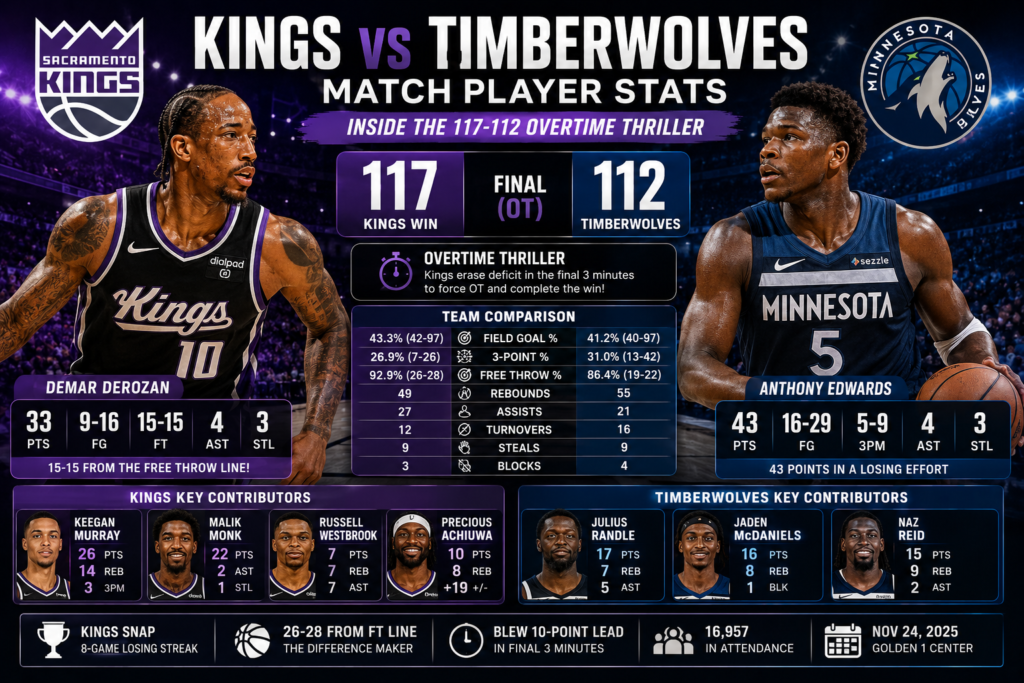
Final score: Kings 117, Timberwolves 112. On paper, that’s a five-point overtime win — the kind of line that gets glanced at and filed away. But the box score hides a wilder story: Minnesota blew a 10-point lead with three minutes left, for the second straight game in two nights, while a Kings team that had lost eight of nine somehow found enough poise to survive a 43-point night from one of the NBA’s best scorers. When you dig into the sacramento kings vs timberwolves match player stats from November 24, 2025, the final margin barely hints at how this game actually flipped.
Team Comparison Table
| Stat | Sacramento Kings | Minnesota Timberwolves |
|---|---|---|
| Points | 117 | 112 |
| Field Goal % | 43.3% (42-97) | 41.2% (40-97) |
| 3-Point % | 26.9% (7-26) | 31.0% (13-42) |
| Free Throw % | 92.9% (26-28) | 86.4% (19-22) |
| Total Rebounds | 49 | 55 |
| Assists | 27 | 21 |
| Turnovers | 12 | 16 |
| Steals | 9 | 9 |
| Blocks | 3 | 4 |
The Kings won despite getting outrebounded by six and out-3-pointed by a wide margin. What flipped it was the free-throw line and the turnover column: Sacramento made 26 of 28 free throws to Minnesota’s 19 of 22, and gave the ball away four fewer times. Those two categories, more than shooting percentage, decided this one.
Final Score and Game Context
The Kings hosted the Timberwolves at Golden 1 Center in Sacramento, California, tipping off at 10:00 PM ET on Monday, November 24, 2025. The game ran two hours and 41 minutes in front of an announced crowd of 16,957. Officials Brandon Adair, Nate Green, and James Williams worked the game, which needed a five-minute overtime period after the teams were tied 101-101 at the end of regulation.
This wasn’t the first meeting between the two teams that month — Minnesota had already beaten Sacramento twice in NBA Cup group play earlier in November — making this result something of an outlier in an otherwise lopsided season series. The win pushed the Kings to 5-13, snapping what had been an eight-game losing streak just two days earlier with a comeback win over Denver. Minnesota fell to 10-7.
Sacramento Kings: Player Performance Breakdown
DeMar DeRozan
DeRozan scored a game-high 33 points on 9-of-16 shooting, going a perfect 15-for-15 from the free-throw line to go with four assists and three steals in nearly 32 minutes. His free-throw shooting was the single biggest swing factor in the box score — 15 makes without a miss, including the two that tied the game at 101 with 34 seconds left in regulation, forced overtime and kept Minnesota’s collapse alive.
Keegan Murray
Murray posted a near double-double-plus line: 26 points on 10-of-19 shooting (3-of-5 from three), with 14 rebounds in 44-plus minutes. He was Sacramento’s rebounding anchor in a game the Kings lost the boards overall, and his ability to space the floor while still crashing the glass gave Sacramento offense-defense balance that its shorthanded frontcourt otherwise lacked.
Malik Monk
Monk came off the bench for 22 points on 9-of-18 shooting, hitting 2 of 7 threes and adding two assists and a steal in just over 26 minutes. Thirteen of his 22 points came in the fourth quarter, exactly when Sacramento needed instant offense to chip into Minnesota’s double-digit lead.
Russell Westbrook
Westbrook filled the box score with seven points, seven rebounds, and seven assists in under 29 minutes, though he also committed four turnovers. His playmaking kept Sacramento’s offense organized in crunch time even as his own shot (3-of-11) struggled to fall — a reminder that a modest scoring line can still carry real value when the assists and defensive activity are high.
Precious Achiuwa
Achiuwa added 10 points and eight rebounds in 34 minutes off the bench, and finished a team-best plus-19 for the game. His frontcourt minutes mattered more than the stat line suggests — with Domantas Sabonis inactive, Achiuwa was tasked with absorbing extra interior minutes against Rudy Gobert and Naz Reid, and Sacramento was significantly better with him on the floor.
Minnesota Timberwolves: Player Performance Breakdown
Anthony Edwards
Edwards was spectacular in defeat, scoring 43 points on 16-of-29 shooting with five made threes, four assists, three steals, and a block in just over 40 minutes. It’s one of the best individual scoring nights of his season, yet Minnesota still lost — a clean example of how one player’s brilliance can be swallowed by a team-wide fourth-quarter and overtime collapse.
Julius Randle
Randle scored 17 points on 5-of-13 shooting with 10 rebounds and five assists, but also committed five turnovers. Those turnovers, several coming in clutch late-game possessions, were part of a bigger Minnesota pattern — the Timberwolves gave the ball away 16 times as a team, and Randle’s giveaways came at moments Minnesota could least afford them.
Donte DiVincenzo
DiVincenzo scored 17 points on 5-of-14 shooting, connecting on 5 of 13 three-point attempts, in just over 37 minutes. He was one of the few Timberwolves who stayed hot from deep as the game slipped away, but his volume from three (13 attempts) also reflected Minnesota settling for jumpers rather than establishing anything inside down the stretch.
Rudy Gobert
Gobert quietly contributed 11 points on 4-of-6 shooting with 13 rebounds in nearly 41 minutes. His rebounding kept Minnesota competitive on the glass all night, but his limited offensive role (just six shot attempts) meant Minnesota leaned heavily on jump-shooting from its guards in the fourth quarter and overtime.
Naz Reid
Reid scored 15 points on 6-of-15 shooting with seven rebounds off the bench in under 24 minutes. His outside shot went cold late (1-of-6 from three) at the exact stretch Minnesota needed secondary scoring to hold off Sacramento’s rally.
Bench and Rotation Performance
Beyond the starters, bench depth swung possessions in both directions. Here’s how each team’s reserves performed as a unit.
| Team | Bench Points | Bench Reb | Bench Ast | Bench TOV | Notable |
|---|---|---|---|---|---|
| Kings | 22 (Monk 22, Schröder 6, Raynaud 1, Clifford 3, Eubanks 2 among reserves/depth) | 19 | 12 | 4 | Monk’s 22 points paced all reserves |
| Timberwolves | 18 (Reid 15, Conley 3, Dillingham 0, Shannon 0, Clark 0) | 13 | 8 | 2 | Reid led, but shooting cooled late |
Sacramento’s bench outscored Minnesota’s, and Monk alone nearly matched the entire Timberwolves reserve corps. That kind of secondary scoring is often the difference in a game decided by single digits — starters traded runs, but the Kings’ depth gave them another gear Minnesota’s bench couldn’t match.
Key Turning Points
First quarter: Minnesota jumped ahead 27-23, with Anthony Edwards scoring 12 points in the opening 12 minutes.
Second quarter: The Timberwolves extended their lead to 54-46 at halftime, again winning the period 27-23, as Edwards and Donte DiVincenzo combined for efficient perimeter shooting.
Third quarter: Sacramento clawed back, outscoring Minnesota 31-28 to trim the deficit to 82-77 heading into the fourth.
Fourth quarter: This is where the game actually turned. Minnesota built a cushion that reached 10 points with roughly three minutes remaining in regulation — the same script that had cost them a game in Phoenix the night before. Sacramento answered with a 24-19 fourth quarter, capped by DeRozan’s two free throws with 34 seconds left that tied the score at 101. Edwards missed a potential go-ahead jumper, and DeRozan and Monk both missed on the final possession, sending the game to overtime.
Overtime: Sacramento outscored Minnesota 16-11 in the extra period, powered by DeRozan’s perfect free-throw shooting and a Murray three-pointer, sealing the 117-112 final.
Why the Kings Won
- DeRozan’s free-throw perfection. Fifteen-for-fifteen at the line, including the two shots that forced overtime, is the single cleanest explanation for the result.
- Bench scoring advantage. Malik Monk’s 22 points off the bench gave Sacramento offense Minnesota’s reserves couldn’t replicate.
- Turnover discipline. The Kings committed just 12 turnovers to Minnesota’s 16, protecting extra possessions in a game decided by five points.
- Free-throw volume. Sacramento shot 28 free throws to Minnesota’s 22, converting the disparity into real point value.
- Fourth-quarter and overtime composure. After trailing by 10 with under three minutes left, Sacramento didn’t panic — it methodically cut the gap and then controlled overtime outright.
Why the Timberwolves Lost
- A late-game collapse, again. Blowing a 10-point lead in the final three minutes echoed Minnesota’s loss in Phoenix the night before — a pattern, not a one-off.
- Turnovers at the worst times. Sixteen team turnovers, several from Julius Randle in clutch situations, handed Sacramento extra chances.
- Free-throw and whistle disadvantage. Minnesota attempted six fewer free throws than Sacramento and shot a worse percentage once there.
- Late shooting cold spells. Naz Reid and others went cold from three exactly when secondary scoring was needed most.
- Over-reliance on one shot creator. With Edwards logging heavy minutes and shot volume, Minnesota’s offense grew predictable once Sacramento’s defense tightened in the fourth quarter and overtime.
Player Comparison Table
| Player | Team | Points | Rebounds | Assists | Main Impact |
|---|---|---|---|---|---|
| DeMar DeRozan | Kings | 33 | 0 | 4 | Perfect 15-15 FT shooting forced OT |
| Anthony Edwards | Timberwolves | 43 | 7 | 4 | Elite scoring wasted in a team loss |
| Keegan Murray | Kings | 26 | 14 | 2 | Two-way anchor, efficient from three |
| Julius Randle | Timberwolves | 17 | 10 | 5 | Costly turnovers in clutch moments |
| Malik Monk | Kings | 22 | 2 | 2 | Bench spark, 13 points in Q4 |
| Donte DiVincenzo | Timberwolves | 17 | 4 | 1 | Hot from three, but high-volume jumpers |
| Precious Achiuwa | Kings | 10 | 8 | 0 | Team-best +19, filled Sabonis’s absence |
| Rudy Gobert | Timberwolves | 11 | 13 | 1 | Glass work, limited offensive role |
Standout Performances That the Score Alone Won’t Show You
Anthony Edwards’ 43 points looks like the headline stat of the night — and in a vacuum, it’s the best individual scoring performance either team produced. But DeMar DeRozan’s 33-point, 15-for-15 free-throw night carries more functional weight, because it happened when Sacramento needed it and directly produced the tying points that forced overtime. A 33-point game with zero misses at the line, delivered in the final minute of a must-win sequence, can matter more than a 43-point game that never turns the game’s outcome.
The same logic applies to Precious Achiuwa’s modest 10-point, 8-rebound line. It won’t show up on any highlight reel, but his team-best plus-19 rating tells you Sacramento’s offense and defense both ran better with him on the floor — filling minutes that would otherwise have gone to a thinner frontcourt rotation with Domantas Sabonis unavailable. Box scores reward volume; game outcomes often reward timing and floor impact instead.
Star vs. Role-Player Irony: A Closer Look
| Metric | Anthony Edwards (Loss) | DeMar DeRozan (Win) |
|---|---|---|
| Points | 43 | 33 |
| Field Goal % | 55.2% | 56.3% |
| Free Throws | 6-8 | 15-15 |
| Plus/Minus | -12 | 0 |
| Result | Loss | Win |
The irony here is straightforward: the best individual scoring performance of the night came from the losing team. Edwards shot a higher volume and comparable efficiency to DeRozan, yet his team finished on the wrong side of the scoreboard while carrying a team-worst minus-12 plus/minus. It’s a clean illustration of why raw scoring totals, viewed in isolation, rarely tell the full story of who actually won a game.
Advanced Interpretation (For Context, Not Prediction)
A few simple derived numbers help explain this result beyond the raw totals — though none of these are predictive on their own, just useful ways to read what already happened.
- Points per field-goal attempt: Sacramento scored 117 points on 97 field-goal attempts, a rate of about 1.21 points per shot. Minnesota scored 112 points on the same 97 attempts, roughly 1.15 points per shot. The gap traces almost entirely back to free-throw production.
- Assist-to-turnover ratio: The Kings posted 27 assists against 12 turnovers, a ratio of 2.25. The Timberwolves posted 21 assists against 16 turnovers, a ratio of 1.31. Sacramento’s ball security, not its shooting, was the bigger separator.
- Free-throw rate: Sacramento attempted 28 free throws against 97 field-goal attempts (a rate of .289); Minnesota attempted 22 against the same 97 (.227). Getting to the line more often — and converting once there — padded Sacramento’s efficiency even though Minnesota’s raw shooting numbers looked comparable.
These numbers aren’t meant to forecast future games between these two teams. They’re a plain-English way of showing why a team can lose the rebounding battle and the three-point battle and still win — because efficiency has more than one input.
Secondary Context: Rebounding, Bench Depth, and What Else Shaped the Game
Minnesota out-rebounded Sacramento 55-49, with Rudy Gobert (13) and Julius Randle (10) doing the heaviest lifting on the glass. Yet total rebounds didn’t translate into more possessions that mattered, because Sacramento’s turnover discipline offset the rebounding gap. Domantas Sabonis’ absence (listed inactive for Sacramento) forced Precious Achiuwa and Maxime Raynaud into larger frontcourt roles than usual, and the fact that Sacramento still out-rebounded Minnesota’s bench units in the fourth quarter and overtime speaks to unheralded effort from role players like Nique Clifford, who grabbed six rebounds in under 12 minutes.
Broader Context: Season Series and Streak Notes
This was Sacramento’s second straight win, coming right after a comeback victory over Denver that snapped an eight-game losing streak. It was Minnesota’s second consecutive late-game collapse in as many nights, following a blown lead in Phoenix. Zoomed out across the 2025-26 season series, Minnesota still held a commanding edge — the Timberwolves had already beaten Sacramento twice earlier in November during NBA Cup group play, and would go on to beat the Kings again on December 14 in Minneapolis, evening the emotional scales after this overtime loss. Sacramento’s win here stood out precisely because the Kings were otherwise near the bottom of the league standings for most of the season.
What These Stats Mean for Future Analysis
When reading any NBA box score like this one, a few categories deserve more attention than raw points:
- Free-throw attempts and conversion rate, since these often decide close games more than field-goal percentage.
- Turnover differential, which reflects ball security under pressure better than any shooting stat.
- Plus/minus by player, which can reveal value that a modest points total hides.
- Bench scoring totals, since reserve production frequently swings games decided by single digits.
- Quarter-by-quarter scoring, which shows when a team actually built or lost its advantage, rather than just the final margin.
What Fantasy and Practical Readers Can Take From This Game
Fantasy managers evaluating players from this specific game should note that Anthony Edwards’ 43-point outburst is a ceiling performance worth tracking for volume-based formats, while DeMar DeRozan’s perfect free-throw night is a reminder that his floor as a high-volume line shooter remains stable even in years when his overall efficiency dips. Malik Monk’s 22-point bench outing is a useful data point for anyone rostering him in a sixth-man or streaming role, since his usage clearly spikes in fourth-quarter minutes. None of these single-game numbers should be extrapolated into season-long projections on their own — one overtime game is one data point, not a trend.
What the Box Score Does Not Tell You
The box score won’t tell you that Minnesota led by 10 points with three minutes to play and still lost — that context lives in the play-by-play, not the totals. It won’t tell you Domantas Sabonis was unavailable for Sacramento, reshaping the frontcourt rotation. It won’t capture the psychological weight of Minnesota blowing a second straight late lead in as many nights, or the fact that Russell Westbrook’s modest scoring line included quietly excellent floor generalship. Raw stat lines are a starting point for understanding a game, not a complete account of it.
How to Read a Box Score Like This One: A Step-by-Step Method
- Start with the final score and the game context — venue, attendance, overtime or not — to frame the stakes.
- Check quarter-by-quarter scoring to identify when the game’s momentum actually shifted, rather than assuming it was decided early or late.
- Compare team-level efficiency stats (field-goal percentage, free-throw rate, turnovers) before looking at individual totals.
- Identify the free-throw and turnover differentials, since these two categories decide more close games than shooting variance.
- Look at plus/minus alongside points, to catch role players whose value doesn’t show up in the scoring column.
- Separate bench production from starter production, since depth often decides games with single-digit final margins.
- Cross-reference the recap or play-by-play for late-game sequencing — box scores alone can’t show you who missed the potential go-ahead shot or who forced the decisive turnover.
Key Takeaways
- The Kings beat the Timberwolves 117-112 in overtime on November 24, 2025, at Golden 1 Center.
- DeMar DeRozan’s 33 points and perfect 15-for-15 free-throw shooting were the decisive individual factor.
- Anthony Edwards scored a game-high 43 points in the loss, illustrating how individual brilliance doesn’t guarantee a win.
- Minnesota blew a 10-point lead in the final three minutes of regulation, its second straight late collapse in as many nights.
- Turnover discipline (12 vs. 16) and free-throw volume (28 vs. 22 attempts) mattered more than rebounding or three-point shooting in deciding the final margin.
FAQ: Sacramento Kings vs Timberwolves Match Player Stats
Who won the Kings vs. Timberwolves game on November 24, 2025? The Sacramento Kings won 117-112 in overtime.
Who led all scorers in the Kings vs. Timberwolves game? Anthony Edwards led all scorers with 43 points for Minnesota, though DeMar DeRozan’s 33 points paced the winning Kings.
Did the Kings vs. Timberwolves game go to overtime? Yes. The teams were tied 101-101 at the end of regulation after Minnesota blew a 10-point lead in the final three minutes, and Sacramento outscored Minnesota 16-11 in the five-minute overtime period.
How many free throws did DeMar DeRozan make? DeRozan made all 15 of his free-throw attempts, the decisive stat line of the game.
Where was the Kings vs. Timberwolves game played? At Golden 1 Center in Sacramento, California, in front of an announced crowd of 16,957.
Was Domantas Sabonis in this Kings vs. Timberwolves game? No. Sabonis was listed inactive for Sacramento, giving Precious Achiuwa and Maxime Raynaud expanded frontcourt roles.
Conclusion
The final score of Kings 117, Timberwolves 112 undersells a game that was really decided by composure, not talent. Anthony Edwards outscored everyone on the floor and still ended up on the losing side, because Minnesota’s fourth-quarter and overtime execution — turnovers, missed free throws, a blown double-digit lead — gave Sacramento just enough openings to survive. DeMar DeRozan’s perfect night at the free-throw line, backed by Keegan Murray’s two-way floor game and Malik Monk’s bench scoring, turned a shorthanded, underachieving Kings roster into a team that could outlast one of the league’s most explosive scorers. Read past the box score’s top line, and this game is less about who scored more and more about who did the small things — free throws, ball security, composure — when it mattered most.