
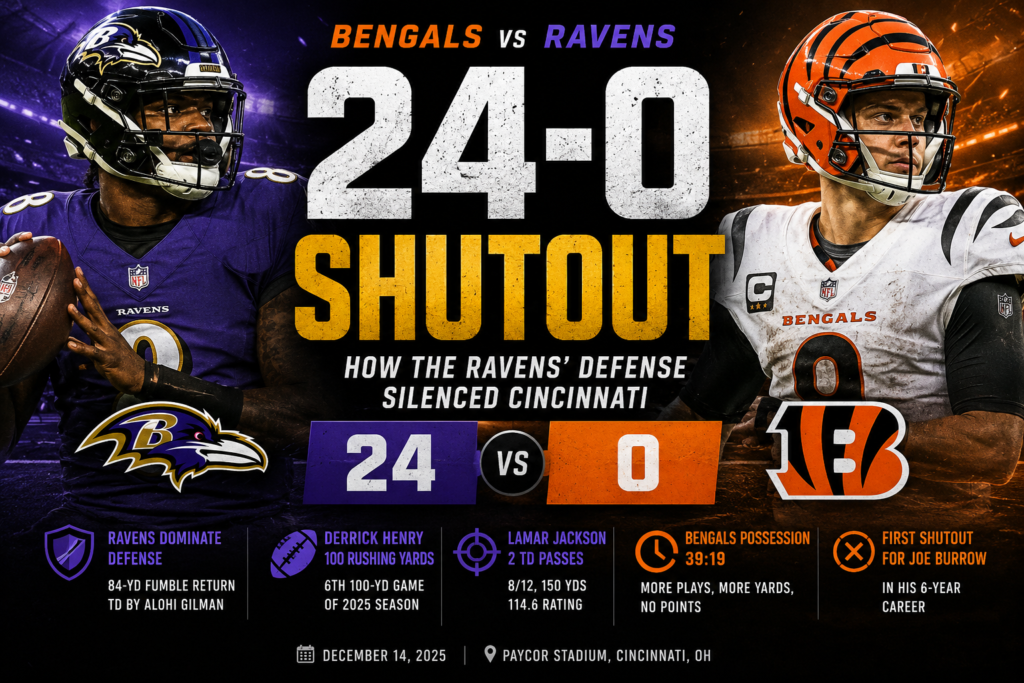
A shutout looks simple on paper — one team scored, the other didn’t. But the December 14, 2025 meeting between the Baltimore Ravens and Cincinnati Bengals, a 24-0 Ravens win at Paycor Stadium, was closer than that number suggests, and messier too. According to CBS Sports’ recap of the game, the Bengals actually out-gained the Ravens in total yards and dominated time of possession, yet finished with zero points for the first time in Joe Burrow’s six-year career. That contradiction — a team winning the stat sheet and losing the scoreboard — is the real story behind these Bengals vs Baltimore Ravens match player stats.
Team Comparison Table
| Stat | Baltimore Ravens | Cincinnati Bengals |
|---|---|---|
| Final Score | 24 | 0 |
| Total Net Yards | 317 | 298 |
| Total Plays | 40 | 71 |
| Net Passing Yards | 128 | 198 |
| Net Rushing Yards | 189 | 100 |
| Time of Possession | 20:41 | 39:19 |
| 3rd Down Conversions | 2-7 | 3-15 |
| 4th Down Conversions | 0-0 | 3-5 |
| Turnovers | 1 | 2 |
| Penalties-Yards | 2-10 | 4-30 |
According to CBS Sports’ official box score for the game, the Bengals ran nearly double the number of offensive plays (71 to 40) and held the ball for almost 19 more minutes, but converted just three of fifteen third downs and came away with nothing to show for it. The Ravens, by contrast, needed only three scoring drives to cover 20 points off touchdowns and a field goal, and let a defensive score cover the rest.
Final Score and Game Context
The game was played at Paycor Stadium in Cincinnati, Ohio, on Sunday, December 14, 2025. It aired on CBS and closed at 24-0 in favor of Baltimore. Per the Associated Press recap carried by CBS Sports, coach John Harbaugh called it the Ravens’ most complete game of the season, coming off what he described as an unusually focused week of practice.
This was the second meeting between the two AFC North rivals in under three weeks. The Bengals had beaten Baltimore 32-14 on Thanksgiving night, November 27, snapping the Ravens’ five-game winning streak. The rematch flipped the outcome entirely — Baltimore avenged that loss and improved to 7-7, while Cincinnati fell to 4-10 and was eliminated from playoff contention with the defeat.
Baltimore Ravens Performance Breakdown
Lamar Jackson
Jackson finished 8 of 12 passing for 150 yards and two touchdowns, adding two carries for 26 yards on the ground. His in-game passer rating for the day sat at 114.6, according to CBS Sports’ box score, built almost entirely in a five-minute window before halftime.
Efficiency mattered more than volume here. Jackson only threw 12 passes all game, but two of them were touchdowns that turned a scoreless game into a two-score lead in the final 42 seconds of the first half — the kind of compressed damage that changes a game’s entire complexion without needing a heavy workload.
Derrick Henry
Henry carried 11 times for 100 yards, his sixth 100-yard rushing game of the 2025 season. His longest run went for 29 yards, and he averaged just over 9 yards per carry on the day.
Henry’s ground production let Baltimore control tempo without needing to expose Jackson to extended drives. With the Ravens’ offense on the field for only 20:41 total, every explosive run mattered — Henry supplied two of them on Baltimore’s field goal drive alone, covering 53 of the possession’s 60 yards himself.
Zay Flowers
Flowers caught 3 of 5 targets for 68 yards and a touchdown, with a long of 28 yards — the score that made it 14-0 right before the half.
That touchdown came on a set of downs that took Baltimore only 42 seconds and five plays to cover 80 yards. Flowers’ catch in the back corner of the end zone was the single biggest个 point swing of the first half, doubling Cincinnati’s deficit in the closing seconds before intermission.
Alohi Gilman
Gilman didn’t touch the ball on offense, but he authored the game’s signature moment: an 84-yard fumble-return touchdown off a Kyle Van Noy interception, the first defensive score of his five-year career.
On third-and-goal from the Ravens’ 7 in the fourth quarter, Burrow was picked off by Van Noy, who lateraled to Gilman for the house call. That single defensive play accounted for a third of Baltimore’s total points and ended any realistic path back into the game for Cincinnati.
Cincinnati Bengals Performance Breakdown
Joe Burrow
Burrow completed 25 of 39 passes for 225 yards, zero touchdowns, and two interceptions, for a game rating of 58.2. Under pressure specifically, he went just 4 of 10 for 59 yards, according to CBS Sports’ game recap.
Burrow himself called it one of the worst games of his career afterward, and the numbers back that up in context: this was the first shutout of his six-year career, and he’d now thrown four interceptions across his last five quarters of football. Volume passing (39 attempts) without a single touchdown is the signature of a stat line that reads as “involved” but produced nothing.
Ja’Marr Chase
Chase caught 10 of 16 targets for 132 yards, easily the best individual receiving performance in the game by yardage.
Ten catches and 132 yards would headline most box scores. Here, it’s a case study in why gross receiving yardage means little without scoring context — Chase’s biggest game of the matchup came in a shutout loss, because none of his catches came inside the red zone at the moments the Bengals needed points most.
Chase Brown
Brown carried 13 times for 53 yards and added 7 catches for 37 yards, giving him 90 total yards from scrimmage.
Brown was Cincinnati’s most complete offensive weapon on the day, both as a runner and a check-down option, but his workload illustrates the Bengals’ broader problem: plenty of moving-the-chains production, none of it converting into points.
Samaje Perine
Perine carried 14 times for 42 yards and caught one pass for a yard.
Perine’s snaps came heavily on Cincinnati’s longest drive of the day — an 11-play, 40-yard march to open the game that ended in a punt. Short, grinding runs kept drives alive without ever threatening the end zone.
Defensive/Pass-Rush Performance
| Player | Team | Tackles (Total-Assist) | Sacks | INT |
|---|---|---|---|---|
| Roquan Smith | BAL | 8-6 | 0 | 0 |
| Demetrius Knight Jr. | CIN | 5-1 | 2.0 | 0 |
| Marlon Humphrey | BAL | 2-0 | 0 | 1 |
| Jordan Battle | CIN | 7-1 | 0 | 1 |
| Kyle Van Noy | BAL | 1-0 | 0 | 1 |
| Myles Murphy | CIN | 2-0 | 2.0 | 0 |
According to CBS Sports’ box score, Baltimore’s defense sacked Burrow three times and forced two interceptions, while Cincinnati’s defense actually out-sacked Baltimore’s pass rush (three sacks to two) and picked off Jackson once. The irony is stark: Cincinnati’s individual defensive stat line was, in places, better than Baltimore’s — Demetrius Knight Jr. logged two sacks and Jordan Battle grabbed an interception — yet none of it stopped the Ravens from controlling the scoreboard, because Baltimore’s offense scored on all three of its meaningful possessions.
Key Turning Points
Late in the first quarter: Neither team found the end zone, but Cincinnati’s opening 11-play, 8:20 drive ended in a punt — an early warning sign that yardage wasn’t translating to points.
4:42 left in the second quarter: Jackson hit Rasheen Ali for a 30-yard touchdown to cap a five-play, 79-yard drive, making it 7-0.
0:29 left in the second quarter: In just 42 seconds and five plays, Baltimore drove 80 yards, capped by Jackson’s 28-yard touchdown to Flowers. That sequence turned a one-score game into a two-score cushion heading into the locker room — arguably the single biggest swing of the afternoon.
9:08 in the third quarter: Tyler Loop’s 27-yard field goal made it 17-0, closing out a drive fueled by two long Henry runs.
7:55 in the fourth quarter: With Cincinnati driving inside the red zone on third-and-goal, Burrow’s pass was intercepted by Van Noy, who lateraled to Gilman for an 84-yard pick-six. That was the knockout blow — a possession that started with the Bengals threatening to cut the deficit in half ended with Baltimore up 24-0.
Why the Ravens Won
- They scored on every drive that mattered. Baltimore ran only 40 total plays but scored touchdowns on back-to-back-to-back meaningful possessions spanning the end of the second quarter into the third.
- Explosive plays over sustained drives. Henry’s 29- and 24-yard runs, plus Jackson’s 32- and 28-yard completions, meant Baltimore didn’t need long, clock-eating drives to put points on the board.
- A defensive touchdown that Cincinnati’s offense couldn’t match. Gilman’s 84-yard pick-six was worth a full touchdown that Baltimore’s offense didn’t have to earn.
- Efficient quarterback play in limited opportunities. Jackson’s 66.7% completion rate and 114.6 rating came on just 12 attempts — no wasted possessions.
- Winning the turnover-to-points math. Baltimore turned the ball over once and gave up zero points off it; Cincinnati turned it over twice and it cost them 7 points directly (the pick-six) plus a missed scoring chance.
Why the Bengals Lost
- Zero points despite 298 total yards. Cincinnati moved the ball consistently but converted almost none of that movement into scoring position that mattered.
- Third-and-long failures. A 3-of-15 third-down conversion rate meant most Bengals drives stalled before reaching field-goal range, let alone the end zone.
- Turnovers at the worst moments. Both of Burrow’s interceptions came on possessions that had reached Baltimore territory, and one directly became the opponent’s longest scoring play of the game.
- Burrow struggled under pressure. Going 4 of 10 for 59 yards when pressured, against a defense that sacked him three times, took away Cincinnati’s biggest weapon in the passing game.
- No red-zone answer. Despite driving into Baltimore territory four times, per the AP recap, the Bengals never scored — their only red-zone trip of the day ended in the pick-six.
Player Comparison Table
| Player | Team | Key Stat Line | Main Impact |
|---|---|---|---|
| Lamar Jackson | BAL | 8/12, 150 yds, 2 TD | Efficient scoring on limited attempts |
| Joe Burrow | CIN | 25/39, 225 yds, 0 TD, 2 INT | High volume, zero conversion to points |
| Derrick Henry | BAL | 11 car, 100 yds | Controlled tempo, chunk-yardage runs |
| Ja’Marr Chase | CIN | 10 rec, 132 yds | Best raw numbers, no scoring impact |
| Zay Flowers | BAL | 3 rec, 68 yds, 1 TD | Game-defining touchdown catch |
| Alohi Gilman | BAL | 84-yd fumble return TD | Single biggest point swing of the game |
| Chase Brown | CIN | 13 car/53 yds, 7 rec/37 yds | Most complete Bengals offensive weapon |
Deep-Dive: The Modest Stat Line That Mattered More
Zay Flowers finished with three catches. Ja’Marr Chase finished with ten. By raw volume, Chase’s day looks vastly superior. But this is where Bengals vs Baltimore Ravens match player stats need context, not just totals.
Flowers’ 3-for-68 line included one catch that ended a Ravens drive in the end zone at the exact moment Baltimore needed to extend its lead before halftime. Chase’s 10-for-132 line, spread across 16 targets in a game where Cincinnati never scored, produced no points at all. A modest catch total that ends in the end zone is worth more than a monster catch total that ends in a punt. This is the core lesson buried in the box score: yardage accumulation and scoreboard impact are not the same currency, and treating them as interchangeable is one of the most common mistakes in reading any game’s stats.
Pitching/Unit Matchup Comparison Table
| Category | Baltimore Defense | Cincinnati Defense |
|---|---|---|
| Sacks | 3 | 2 |
| Interceptions | 2 | 1 |
| Points Allowed | 0 | 24 |
| Turnovers Forced | 2 | 1 |
The irony here is direct: Cincinnati’s defense forced a turnover, notched two sacks, and held Baltimore to just 128 net passing yards — a genuinely solid defensive outing — yet it’s the losing side’s unit. Baltimore’s defense, with one more sack and one more interception, gets full credit in the box score even though the game was ultimately decided by one defensive touchdown plus a passing offense that scored efficiently, not by a defensive rout.
Advanced Interpretation
A few simple derived numbers sharpen the picture, with the disclaimer that none of this is predictive of future matchups — it’s just a clearer lens on this specific one.
- Yards per play: Baltimore averaged 7.9 yards per play; Cincinnati averaged 4.2. Even though Cincinnati ran 31 more plays, Baltimore was nearly double as efficient per snap.
- Points per drive: Baltimore scored on 3 of roughly 9 possessions; Cincinnati scored on 0 of 9. That’s a stark conversion gap that raw yardage numbers hide entirely.
- Third-down conversion rate: Baltimore converted 28.6% (2-of-7); Cincinnati converted 20% (3-of-15). Neither was strong, but Cincinnati needed far more opportunities to get there.
These ratios exist to illustrate what happened in this specific game — they say nothing about how either team will perform in a future matchup.
Secondary Context: Baserunning, Defense, and Small Details
Special teams and situational football tilted subtly toward Baltimore too. The Ravens’ return game generated 148 total return yards against Cincinnati’s 108, and Baltimore committed only two penalties for 10 yards compared to Cincinnati’s four for 30. Field position and discipline, while not headline numbers, compounded Cincinnati’s difficulty sustaining drives into scoring range.
Injuries also shaped depth on both sides. Baltimore lost linebacker Teddye Buchanan for a stretch and had two cornerbacks banged up in the second half. Cincinnati was hit harder, losing wide receiver Charlie Jones early and having tight end Noah Fant, defensive tackle Kris Jenkins Jr., and tackle Amarius Mims all leave with injuries in the second half, according to the CBS Sports recap — attrition that thinned an offense already struggling to finish drives.
Broader Context: Series and Streaks
This was the fourth time Baltimore has shut out Cincinnati, and it was the first time the Bengals had been blanked since their 2017 season opener — also against the Ravens. Baltimore improved to 7-7 and pulled within a half-game of Pittsburgh in the AFC North, while extending its streak to four straight road wins. Cincinnati fell to 4-10 and was mathematically eliminated from playoff contention with the loss. The season series split 1-1, with each team blowing the other out on its home-ish turf — Cincinnati by 18 on Thanksgiving, Baltimore by 24 three weeks later.
What These Stats Mean for Future Analysis
When reading a lopsided box score like this one, a few checkpoints help separate signal from noise:
- Compare time of possession against points scored — a large gap (like Cincinnati’s 39:19 to zero points) signals inefficiency, not dominance.
- Check third- and fourth-down conversion rates before trusting total yardage as a measure of control.
- Look at where turnovers occurred on the field, not just how many happened — a pick-six is worth far more than a turnover at midfield.
- Separate “garbage time” or non-threatening yardage from plays run inside the opponent’s 20-yard line.
What Fantasy and Practical Readers Can Take From the Game
Chase’s 10-catch, 132-yard line looked great on a fantasy scoreboard despite the Bengals being shut out — a reminder that fantasy production and real-game impact can diverge sharply. Henry’s 100-yard, zero-touchdown day was still efficient value on 11 carries. Burrow’s 39 pass attempts with zero touchdowns is the clearest warning sign in the game: heavy volume without scoring is often a symptom of a broken offensive rhythm, not a green light for continued high-volume fantasy usage in obviously game-script-driven situations.
What the Box Score Does Not Tell You
Numbers can’t fully capture why Cincinnati’s offense stalled repeatedly in Baltimore territory, or what specific coverage busts and protection breakdowns led to Burrow’s two interceptions. It doesn’t capture Zac Taylor’s postgame frustration or the locker-room mood after a shutout loss. It also can’t measure momentum shifts in real time — the emotional weight of the Gilman pick-six landed differently in the stadium than it does as a single line in a stat sheet.
Step-by-Step Practical Reading Method
- Start with the final score, then immediately check total yards and time of possession for context.
- Compare third- and fourth-down conversion rates for both teams.
- Identify each team’s scoring drives specifically — how many plays, how much time, how many yards.
- Cross-reference turnovers with field position when they happened.
- Review individual stat lines for volume versus efficiency (completion percentage, yards per carry, catch rate).
- Check special teams and penalty numbers for hidden field-position advantages.
- Read the official recap for injury notes and coaching quotes that explain decisions the raw numbers can’t.
Key Takeaways
Baltimore won despite fewer plays and less time of possession, powered by efficient scoring drives and one defining defensive touchdown. Cincinnati outgained Baltimore in total yardage but converted almost none of it into points, undone by third-down failures and turnovers in scoring territory. Individual stat lines like Chase’s 10-for-132 or Burrow’s 225 passing yards look strong in isolation but carried little scoreboard impact in this particular game.
FAQ
What was the final score of the most recent Bengals vs Baltimore Ravens game?
Baltimore won 24-0 over Cincinnati on December 14, 2025, at Paycor Stadium.
Who had the best individual stats in the Bengals vs Ravens matchup?
By raw yardage, Ja’Marr Chase led all players with 10 catches for 132 yards, though his team was shut out. By game impact, Alohi Gilman’s 84-yard pick-six and Lamar Jackson’s two touchdown passes were more decisive.
Did Joe Burrow throw for a touchdown in the December 2025 game against Baltimore?
No. Burrow completed 25 of 39 passes for 225 yards with zero touchdowns and two interceptions.
How many times has Baltimore shut out Cincinnati?
This was the fourth time the Ravens have shut out the Bengals, and the first time Cincinnati had been blanked since its 2017 season opener, also against Baltimore.
Did the Bengals and Ravens split their 2025 season series?
Yes. Cincinnati won the Thanksgiving night meeting 32-14 on November 27, 2025, and Baltimore won the rematch 24-0 on December 14, 2025.
Why did Cincinnati lose despite gaining more total plays and holding the ball longer?
The Bengals converted just 3 of 15 third downs and turned the ball over twice, including an interception returned 84 yards for a touchdown, while never finishing a drive with points.
Conclusion
The scoreboard from Baltimore’s 24-0 win says the Ravens dominated; the underlying Bengals vs Baltimore Ravens match player stats say the game was far more competitive than that, right up until it wasn’t. Cincinnati out-snapped, out-possessed, and nearly out-gained Baltimore, but converted none of that volume into points, while the Ravens turned a handful of efficient, explosive plays — and one decisive defensive touchdown — into a comfortable final margin. Joe Burrow’s franchise-first shutout and Ja’Marr Chase’s quiet 132-yard day sit at the center of that contradiction, proof that box-score volume and game-deciding impact are two very different things. Three weeks after Cincinnati blew Baltimore out on Thanksgiving, the rematch flipped entirely — a reminder that in the AFC North, one week’s dominant stat line rarely guarantees the next.