
Introduction
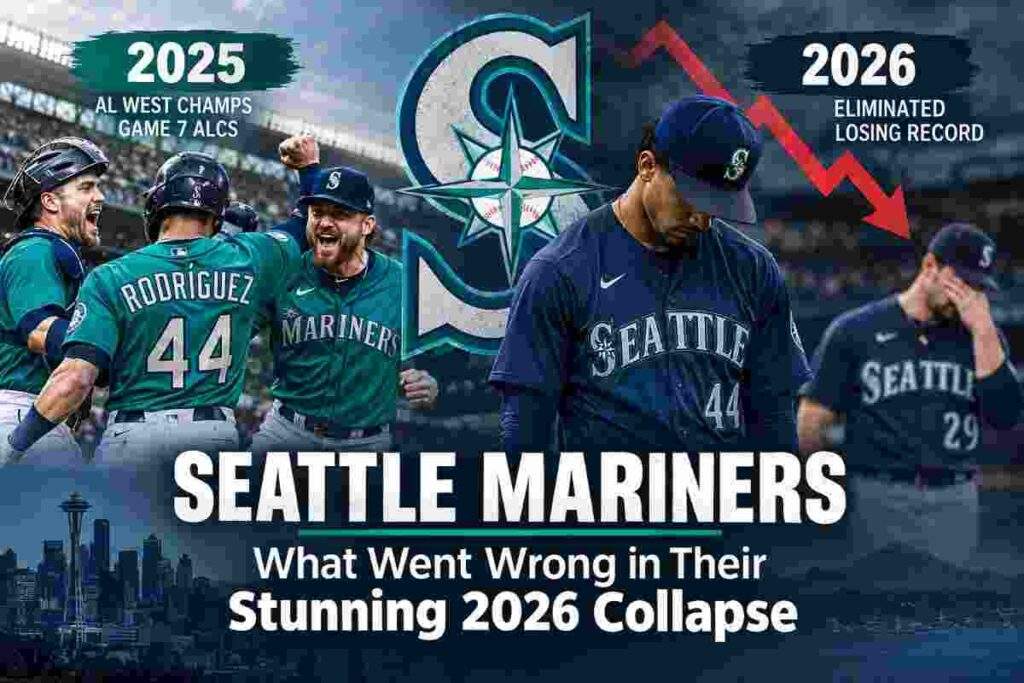
A year ago, the Seattle Mariners were one win away from their first World Series appearance in franchise history. Twelve months later, they were officially eliminated from playoff contention with a losing record, their season ending not with a dramatic Game 7 but with a quiet, inevitable whimper weeks before the regular season even finished. Few teams in recent memory have fallen as far, as fast, as the 2026 Mariners.
If you’re searching for Seattle Mariners coverage to understand what happened this season, this breakdown covers the collapse in detail, the key factors behind it, and what it means for the organization heading into the offseason.
From Game 7 of the ALCS to a Losing Record
The scale of this collapse only makes sense in the context of where Seattle was a year earlier. The Mariners won the AL West in 2025 and reached Game 7 of the American League Championship Series, falling just short of the franchise’s first World Series berth. Entering 2026, they weren’t just a trendy pick to return to the postseason — many considered them legitimate World Series favorites, with a roster that, on paper, looked even stronger than the one that had come within a game of the Fall Classic.
Instead, Seattle was officially eliminated from playoff contention on September 24, 2026, after the Texas Rangers beat the New York Mets, closing the door on Seattle’s increasingly faint postseason hopes. The Mariners finished with a 73-85 record, their first sub-.500 season since 2019 and the end of five consecutive winning seasons. Remarkably, the two ALCS participants from the year before — Seattle and the Toronto Blue Jays — both finished under .500 in 2026, something that hadn’t happened since 1987.
What Actually Went Wrong
Offensive Collapse Across the Lineup’s Core
The most significant factor was a dramatic offensive decline from Seattle’s three most important hitters. Cal Raleigh went through a prolonged hitting slump that sapped the lineup’s power. Julio Rodríguez finished with the worst season of his five-year career. First baseman Josh Naylor managed just one home run in an 83-game stretch at one point in the season. With Raleigh, Rodríguez, and Naylor all struggling simultaneously, the offensive potential that had carried Seattle to the ALCS the year before simply cratered.
A Rocky Start at the World Baseball Classic
The season’s trouble arguably began before it even started — Seattle’s 2026 campaign veered off course right from the World Baseball Classic in March, an early disruption that set an unsteady tone for the year ahead.
Pitching Depth Strategy Backfired
Seattle attempted to keep six starting pitchers in its rotation simultaneously for a stretch of the season, a decision that ended up taxing the bullpen significantly. The club later traded starter Luis Castillo to the Chicago White Sox in August, reshaping the rotation mid-season. Since the All-Star break specifically, Seattle’s pitching staff ranked among the worst in all of baseball — a stunning reversal for a team that had historically been able to rely on its pitching even when the offense struggled.
Injuries and Self-Inflicted Mistakes
Beyond the performance decline, the team dealt with a number of key injuries throughout the season. Manager Dan Wilson, addressing the team’s collapse publicly, described it as “a collective failure,” pointing to a season defined by countless self-inflicted lapses rather than any single explainable cause.
The Final Stretch
Even in a lost season, Seattle found pockets of competitive baseball down the stretch — including a thrilling 6-5 win over the Houston Astros in what proved to be one of the last meaningful moments of the campaign. But with the Rangers and Astros both needing to stumble for Seattle to have any realistic path back into the race, the math simply ran out. The Mariners closed the season with a four-game series against the Los Angeles Angels at T-Mobile Park, which also coincided with a celebration for longtime broadcaster Rick Rizzs, who retired at season’s end.
What This Means Going Forward
Real Questions About Organizational Direction
The collapse has raised genuine questions about Seattle’s competitive direction going into the offseason, including the future status of manager Dan Wilson and his coaching staff. A season this disappointing, following a season that came within one win of a World Series appearance, naturally invites scrutiny of what changes — if any — the organization needs to make.
A Roster With Real Talent, Despite the Record
Starting pitcher Logan Gilbert, Seattle’s longest-tenured starter, pushed back on the idea that the collapse reflected a lack of effort, telling reporters the issue wasn’t a lack of trying. That distinction matters for how the organization evaluates the season — a talented roster underperforming is a different problem to solve than a roster that’s simply no longer good enough.
Common Mistakes When Evaluating a Collapse Like This
- Blaming a single player or decision for an entire season’s collapse. Seattle’s decline involved simultaneous offensive struggles from three core players, pitching staff regression, and roster management decisions — reducing it to one cause oversimplifies what actually happened.
- Assuming last year’s success guarantees anything. Seattle entered 2026 as a trendy World Series pick based largely on the prior year’s ALCS run, and the season is a strong reminder that roster talent on paper doesn’t guarantee results.
- Overlooking the compounding effect of early-season disruptions. The World Baseball Classic disruption in March is easy to dismiss as a minor footnote, but team personnel pointed to it as part of a season that struggled to find its footing from the start.
- Ignoring pitching depth decisions as a factor. The six-starter rotation experiment and its impact on bullpen usage is a good example of a roster-management decision with consequences that weren’t fully apparent until months later.
Best Practices for Following a Story Like This
- Check official standings and elimination scenarios directly through MLB.com rather than relying on secondhand recaps, especially during a tight late-season race.
- Look at team-wide performance trends across a full season rather than judging a collapse off any single bad stretch or game.
- Pay attention to organizational statements from management and veteran players, since they often provide more complete context than box scores alone.
- Track roster and pitching staff decisions throughout a season, since moves like a mid-season trade can have ripple effects that only become clear later.
Personal Experience
I started following this story mainly out of disbelief at the headline — a team that had been one win away from the World Series finishing the very next season with a losing record is the kind of reversal that doesn’t happen often in modern baseball. Digging into the actual breakdown, what struck me most wasn’t any single explanation, but how many different factors seemed to compound at once: three of the lineup’s most important hitters all struggling simultaneously, a pitching staff that had been a strength completely cratering after the All-Star break, and a roster-management decision around starting pitching depth that backfired in ways that weren’t obvious in real time.
What also stood out was Dan Wilson’s own description of it as a “collective failure” rather than pointing to any single culprit. That kind of honest framing from within the organization carries real weight — it suggests this wasn’t a case of bad luck or a few unfortunate bounces, but a genuinely broad decline across multiple parts of the roster at the same time.
The other thing that stuck with me was Logan Gilbert’s comment about it not being a lack of trying. It’s a good reminder that a disappointing record doesn’t automatically mean a lack of effort or buy-in from the players involved — sometimes a talented roster simply underperforms across the board, and the explanation is more complicated than any single storyline can capture.
FAQs
1. What was the Seattle Mariners’ final record in 2026? The Mariners finished 73-85, their first sub-.500 season since 2019, ending a streak of five consecutive winning seasons.
2. When were the Mariners eliminated from playoff contention in 2026? Seattle was officially eliminated on September 24, 2026, after the Texas Rangers beat the New York Mets, closing off Seattle’s remaining path back into the AL West race.
3. What were the main reasons behind the Mariners’ collapse? A combination of factors, including offensive struggles from Cal Raleigh, Julio Rodríguez, and Josh Naylor, a pitching staff that significantly regressed after the All-Star break, a roster-management decision to run six starting pitchers that taxed the bullpen, and a disruptive start at the World Baseball Classic in March.
4. How does this compare to the Mariners’ 2025 season? It’s a dramatic reversal — Seattle won the AL West and reached Game 7 of the ALCS in 2025, making the 2026 collapse to a losing record one of the more notable single-season turnarounds in recent MLB history.
5. Is manager Dan Wilson’s job in jeopardy after this season? The collapse has raised real questions about the organization’s competitive direction, including the future of Wilson and his coaching staff, though no official decision had been confirmed as of the end of the season.
Conclusion
The 2026 Seattle Mariners season will likely be remembered as one of the most disappointing in franchise history, not for lacking talent, but for how completely a roster that came within one win of the World Series the year before fell apart across nearly every phase of the game. From a cratering offensive core to a late-season pitching collapse and a roster decision that backfired, the Mariners’ fall from ALCS contender to sub-.500 finisher offers a genuine lesson in how quickly fortunes can shift in professional sports, regardless of a team’s talent on paper.
Actionable takeaways:
- Look at full-season performance trends rather than judging a team off any single stretch, good or bad.
- Pay attention to roster-management decisions, like pitching depth strategy, since their consequences aren’t always immediately visible.
- Check official team and league sources for accurate standings and elimination scenarios.
- Treat preseason expectations as just that — expectations, not guarantees, regardless of the prior season’s results.
For further reading on the Mariners and the surrounding 2026 MLB season, see ESPN’s MLB coverage, The Athletic’s in-depth Mariners analysis, and FanGraphs’ advanced sabermetric statistics and team analysis.
If you’re following MLB storylines like this alongside your regular news reading, Dailynewstime is worth a look for broader daily coverage.
Disclaimer: This article is for general informational purposes only and reflects publicly available information current as of the time of writing. Team records, personnel decisions, and organizational statements may change — always check official sources like MLB.com for the most current data. This content is not affiliated with or endorsed by MLB or the Seattle Mariners.