
Introduction
Six-seed against three-seed matchups don’t usually get circled on the calendar the way this one did. The Minnesota Timberwolves vs Denver Nuggets first-round series in the 2026 NBA playoffs pitted a Nuggets team still built around Nikola Jokic against a Minnesota roster that had already proven, in recent postseasons, it wasn’t intimidated by seeding on paper. What followed was a genuinely competitive six-game series that ended with a statement performance from an unexpected source.
If you’re searching for Timberwolves vs Nuggets match player stats, whether for fantasy research, betting context, or catching up on a series you missed, this breakdown covers the full results, the decisive Game 6 box score, and the individual performances that actually swung it.
The Series at a Glance
Minnesota and Denver split the first four games before the Timberwolves closed out the series on their home floor:
- Game 1 (Denver): Nuggets 116, Timberwolves 105
- Game 2 (Denver): Timberwolves 119, Nuggets 114
- Game 3 (Minnesota): Timberwolves 113, Nuggets 96
- Game 4 (Minnesota): Timberwolves 112, Nuggets 96
- Game 5 (Denver): Nuggets 125, Timberwolves 113
- Game 6 (Minnesota): Timberwolves 110, Nuggets 98
Minnesota won the series 4-2, closing it out at home before advancing to face the San Antonio Spurs in the Western Conference Semifinals, a series Minnesota would ultimately lose 4-2 as San Antonio continued its run to the NBA Finals.
Game 6 Box Score Breakdown
Team Totals
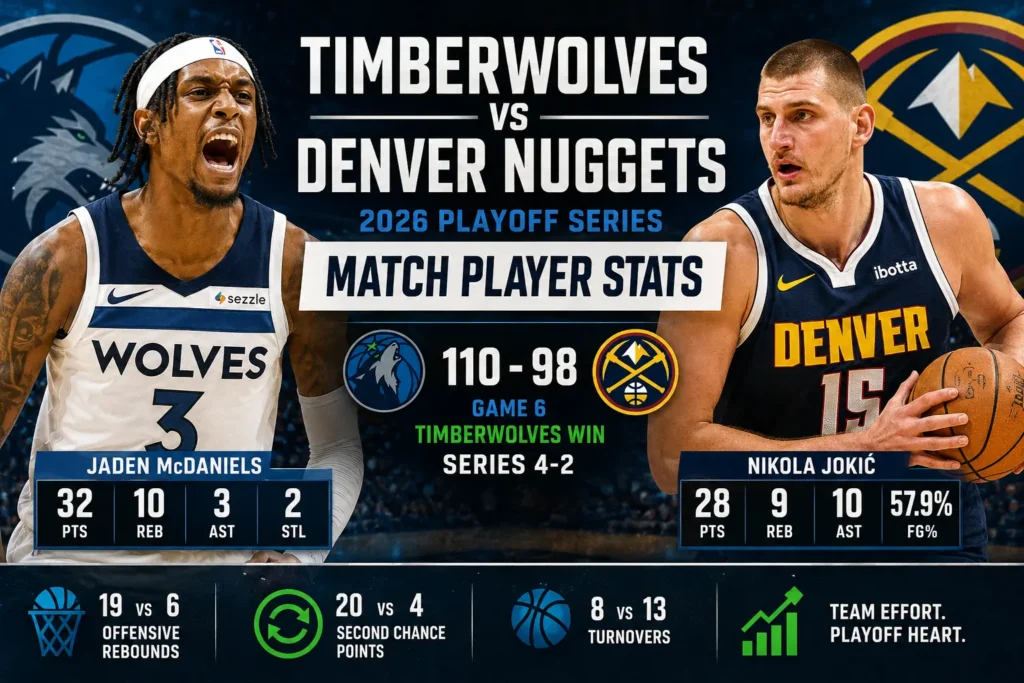
Minnesota shot 45.7% from the field compared to Denver’s 45.3%, a virtual coin flip on efficiency, but the Timberwolves controlled the game in two other areas: the offensive glass, where they out-rebounded Denver 19-6, and second-chance points, where Minnesota’s 20 nearly quintupled Denver’s 4. Minnesota also turned the ball over just 8 times compared to Denver’s 13, giving them extra possessions on top of the rebounding edge.
Jaden McDaniels’ Breakout Performance
The story of Game 6 was Jaden McDaniels, who exploded for 32 points on 13-of-25 shooting, adding 10 rebounds for a double-double, 3 assists, and 2 steals. His scoring output was nearly matched by his efficiency in the paint, where he went 8-for-16, and his plus-16 rating led all Minnesota starters.
Terrence Shannon Jr. Provided Instant Offense
Off the bench, Terrence Shannon Jr. added 24 points on 9-of-20 shooting, including a perfect 5-for-5 from the free-throw line, giving Minnesota a genuine scoring punch beyond its regular starting lineup.
Rudy Gobert’s Defensive Anchor Role
Center Rudy Gobert didn’t put up gaudy scoring numbers, finishing with 10 points, but his 13 rebounds (7 offensive) and 8 assists rounded out a genuine double-double, and his defensive rating of 104.8 was the best mark among Minnesota’s core rotation players.
Nikola Jokic and Denver’s Response
Nikola Jokic did what Jokic does, posting a double-double with 28 points, 9 rebounds, and 10 assists on 57.9% shooting. Cameron Johnson added 27 points, shooting an efficient 50% from three-point range. But Denver got comparatively little from Jamal Murray, who struggled to just 12 points on 23.5% shooting from the field, a significant inefficiency that hurt Denver’s ability to keep pace once Minnesota built its cushion.
The Turning Point
Minnesota’s second quarter was the difference-maker, where they outscored Denver 28-20 after a near-even first period. That swing, combined with a dominant offensive rebounding effort throughout the game, gave the Timberwolves enough separation that Denver’s fourth-quarter push wasn’t enough to complete the comeback.
Series-Long Player Performance Trends
Minnesota’s Depth Beyond Its Stars
Across the series, Minnesota consistently got scoring from multiple sources — McDaniels, Shannon Jr., Julius Randle, and Naz Reid all had moments as the series’ primary scoring option on different nights, which made Minnesota harder to game-plan against than a roster reliant on just one or two players.
Jokic’s Consistency vs. Supporting Cast Variance
Jokic was remarkably steady across the series, but Denver’s results tracked closely with how well the players around him performed — when Murray, Johnson, and the bench found their rhythm, Denver was competitive; when they didn’t, as in Game 6, the burden on Jokic alone wasn’t enough to overcome Minnesota’s depth.
Rebounding Was a Series-Long Theme
Minnesota’s offensive rebounding advantage in Game 6 wasn’t an outlier — extra possessions off the glass were a recurring factor across the series, giving Minnesota more scoring chances than the raw shooting numbers alone would suggest, and reflecting a genuine size and effort advantage in the frontcourt.
Common Mistakes When Reading Playoff Series Stats Like This
- Judging the series purely by Jokic’s individual numbers. Jokic’s box score rarely tells the full story of a Nuggets loss — his teammates’ efficiency, not his own production, was usually the bigger swing factor across this series.
- Overlooking bench scoring. Terrence Shannon Jr.’s 24-point Game 6 off Minnesota’s bench was a series-long pattern worth tracking, not a one-off performance, and it’s exactly the kind of secondary production that decides close playoff games.
- Ignoring offensive rebounding differentials. Shooting percentages get most of the attention, but Minnesota’s advantage on the offensive glass consistently created more scoring opportunities than field goal attempts alone would show.
- Treating a 4-2 series result as more lopsided than it was. Minnesota’s two losses, including a 125-113 Game 5 defeat, show this was a genuinely competitive series decided by a handful of possessions in specific games, not a runaway.
Best Practices for Following a Playoff Series Like This
- Check the full game-by-game results before drawing conclusions from a single box score, since playoff series often shift based on in-series adjustments.
- Look at team rebounding and turnover differentials alongside shooting percentages for a fuller picture of what actually decided a close game.
- Use official sources like NBA.com or Basketball-Reference for verified box scores rather than relying on secondhand recaps.
- Pay attention to which role players are having strong individual games, since they often explain series swings better than star player performances alone.
Personal Experience
I followed this series partly because I had Rudy Gobert on a fantasy defense-and-rebounding-focused roster, and partly out of general curiosity about whether Minnesota could genuinely compete with a Jokic-led Denver team in a playoff setting. What stood out watching Game 6 unfold was how little Jokic’s individual dominance actually mattered to the final outcome — a 28-point, near triple-double performance from arguably the league’s best player still wasn’t enough, because the supporting cast around him had an off night at the wrong time.
That was a useful reminder that I’d been over-indexing on star player box scores when trying to predict playoff outcomes. Watching Jaden McDaniels put up 32 points in a closeout game was the actual headline of the night, and it wasn’t a performance I’d have predicted based on his regular-season scoring average — playoff breakout games from secondary options are genuinely hard to forecast, and they’re often the actual deciding factor in a series like this one.
The other thing that stuck with me: Minnesota’s offensive rebounding numbers in Game 6 (19 offensive boards to Denver’s 6) were dramatic enough that I went back and checked the earlier games in the series, and found that advantage showed up consistently across the whole matchup, not just the finale. It reinforced something I try to keep in mind now with any close series — checking rebounding and possession-level stats, not just who scored the most points, usually gives a more honest read on what’s actually deciding the games.
FAQs
1. Who won the Timberwolves vs Nuggets 2026 playoff series? The Minnesota Timberwolves won the series 4-2, closing it out with a 110-98 win in Game 6 at home after the two teams split the first four games.
2. Who had the best individual performance in the deciding Game 6? Jaden McDaniels led all scorers with 32 points and added 10 rebounds for a double-double, while Nikola Jokic posted a 28-point, 9-rebound, 10-assist double-double for Denver in the loss.
3. What decided the Timberwolves-Nuggets series? Minnesota’s depth beyond its top scorers, consistent offensive rebounding advantages, and lower turnover totals were recurring factors, culminating in a dominant Game 6 where Minnesota out-rebounded Denver on the offensive glass 19-6.
4. How far did Minnesota advance after beating Denver? The Timberwolves went on to face the San Antonio Spurs in the Western Conference Semifinals, a series they lost 4-2 as San Antonio continued its eventual run to the NBA Finals.
5. Where can I find the official box scores for this series? Verified box scores and game logs are available through NBA.com’s official stats section and Basketball-Reference, both of which track official league data for every playoff game.
Conclusion
The Timberwolves vs Nuggets 2026 first-round series delivered exactly the kind of competitive, momentum-shifting basketball that makes six-game playoff matchups worth digging into after the fact. Minnesota’s depth, led by an unexpected 32-point outburst from Jaden McDaniels in the closeout game, proved to be the deciding factor over a Denver team that had Nikola Jokic playing at an elite level but couldn’t consistently get enough from the supporting cast around him. Beyond just who won, the series is a useful reminder that possession-level stats — rebounding, turnovers, bench scoring — often tell a more complete story than a single superstar’s box score.
Actionable takeaways:
- Look at rebounding and turnover differentials, not just star player scoring, when evaluating what decided a close playoff game.
- Track bench and secondary scoring performances across a series, since they often explain swings better than headline numbers.
- Check the full game-by-game series log rather than judging a series solely by its final result.
- Use verified official sources for box score data rather than relying on secondhand recaps.
If you’re building a sports content site or fan community around data-driven breakdowns like this one, Dailynewstime is worth a look for the broader toolset behind that kind of build.
For further reading on this series and the surrounding 2026 playoffs, see ESPN’s NBA playoff coverage, The Athletic’s in-depth playoff analysis, and Cleaning the Glass’s advanced NBA statistics and shot-quality breakdowns.
Disclaimer: This article is for general informational purposes only and reflects publicly available statistics from the 2026 NBA playoffs. Player stats and series results are accurate as of the time of writing — always check official sources like NBA.com for the most current data. This content is not affiliated with or endorsed by the NBA, the Minnesota Timberwolves, or the Denver Nuggets.