
Introduction
Search “Washington Nationals vs New York Yankees match player stats” and you’ll find the same thing over and over: a table of hits, runs, and home runs with zero context about what any of it means. That’s not useful if you’re trying to actually understand how these two teams matched up, who carried the load, or what the numbers say about where each roster stands heading into the stretch run.
I went back through all three games of the Yankees’ series at Nationals Park (July 10–12, 2026), cross-referenced box scores from ESPN, Baseball-Reference, CBS Sports, and MLB.com, and layered in season-long context for the key players involved — James Wood, CJ Abrams, Ben Rice, Jazz Chisholm Jr., and more. What follows isn’t a copy-paste of a scoreboard. It’s a full picture of Nationals vs Yankees player stats, what they reveal about each team’s identity in 2026, and a few storylines — an MLB debut, a managerial milestone, an intra-team home run competition — that most recaps skipped entirely.
Series Snapshot: Yankees Complete a Three-Game Sweep
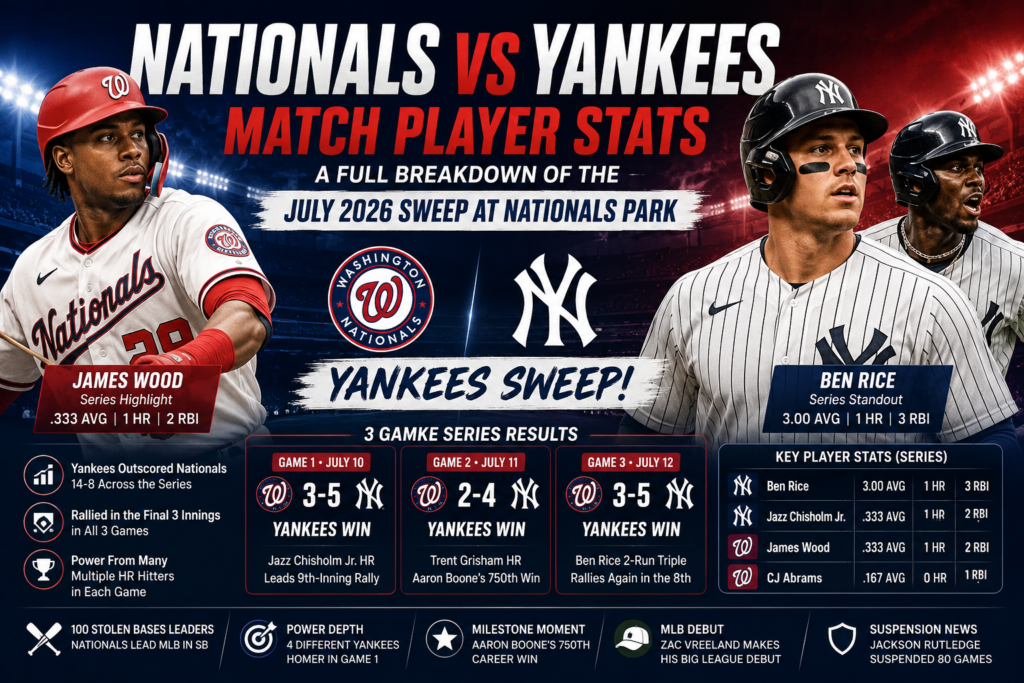
The Yankees took all three games from the Nationals at Nationals Park, outscoring Washington 14-8 across the set:
- Game 1 (July 10): Yankees win, 5-3. Jazz Chisholm Jr.’s two-run homer in the ninth inning broke the game open.
- Game 2 (July 11): Yankees win, 4-2. Trent Grisham’s two-run homer in the eighth inning did the damage, and Aaron Boone picked up his 750th career win as Yankees manager in the process.
- Game 3 (July 12): Yankees win, 5-3. Ben Rice’s two-run triple in the eighth capped a series in which New York rallied from a deficit in the final three innings in back-to-back-to-back games.
That’s the headline. But the player-level stats tell a much more layered story than “Yankees swept the Nationals” — and if you’re researching this matchup for fantasy baseball, betting, or just following both rosters, the details below matter more than the final scores.
Game 1 (July 10): A Late Yankees Explosion
Washington entered the series opener in decent form, having taken two of three from the Houston Astros and won seven of their previous 11 games. The Nationals also came in leading all of MLB in runs scored (508) and stolen bases (100) at that point in the season — numbers that reflect an offense built for speed and contact as much as power.
The game itself, though, went to New York’s power bats:
- Ben Rice opened the scoring with a solo home run — his 29th of the season — off Nationals opener Carson Palmquist in the top of the first.
- Dylan Crews got Washington on the board with an RBI groundout in the third.
- Jasson Domínguez hit a solo homer, his fifth of the season, off reliever Zack Littell in the fourth to make it 2-1.
- Washington threatened repeatedly late — stranding runners at third in the fourth and sixth innings — but couldn’t convert.
- Jazz Chisholm Jr. delivered the decisive blow, a two-run homer in the top of the ninth.
- Austin Wells added an insurance solo shot later in the ninth, his sixth of the season, to make it 5-3.
Final tally for New York’s home run hitters that day: Rice, Domínguez, Chisholm Jr., and Wells all left the yard — four different Yankees going deep in a single game against Washington pitching. That kind of power distribution, rather than one player carrying the offense, is a pattern that shows up again and again when you dig through the Yankees’ 2026 box scores.
On the mound, Ryan Weathers started for New York and worked around traffic before handing things to the bullpen; the Nationals countered with an opener-and-bulk-reliever combination of Palmquist and Littell, a strategy Washington has leaned on repeatedly this season given rotation depth issues.
Game 2 (July 11): Grisham’s Homer and a Bullpen That Couldn’t Hold
Game 2 was tighter on paper — New York out-hit Washington 9-7 with three home runs to the Nationals’ two, and out-gained them 19 total bases to 13 — but the story was about when the damage happened, not just how much of it there was.
Washington’s bullpen held a lead into the late innings before Trent Grisham’s two-run homer in the eighth flipped the result. It was the second straight game the Yankees had needed a big swing in the final innings to win, and it wouldn’t be the last time that inning specifically decided the outcome in this series.
This win also carried a milestone that got buried under the scoreline: it was Aaron Boone’s 750th career win as Yankees manager. Boone has now spent parts of nine seasons at the helm in the Bronx, and reaching that number in the middle of a series sweep — rather than in some marquee nationally televised game — is a fitting way for a milestone like that to land during a 162-game season.
Game 3 (July 12): The Most Complete Player-Stat Story of the Series
If you only read one box score from this series, make it this one. Game 3 had home runs, a pinch-hit tying shot, a costly error, a big-league debut, and a suspension storyline all packed into one afternoon.
Scoring sequence:
- James Wood opened the scoring with a solo home run off Will Warren in the bottom of the first — his 27th homer of the season at the time.
- Jazz Chisholm Jr. and Austin Wells each drove in a run for New York in the top of the fifth to tie the game.
- Curtis Mead, entering as a pinch hitter, launched a solo home run in the sixth to retie it for Washington.
- A Jazz Chisholm Jr. throwing error in the seventh let Washington briefly reclaim the lead, 3-2.
- Ben Rice’s two-run triple off Andrew Alvarez in the eighth — a ball center fielder Dylan Crews couldn’t corral while crashing into the wall — put the Yankees back in front for good, 4-3.
- Jonathan Caballero added a sacrifice-fly RBI in the ninth for the final 5-3 margin.
On the pitching side, Ryan Yarbrough picked up the win, Andrew Alvarez took the loss, and Paul Blackburn recorded his first save of the season, retiring the final six Washington batters he faced. Cade Cavalli started for Washington in his first outing since serving a five-game suspension tied to a bench-clearing incident in Boston on June 30 — he allowed two runs and four hits across six innings, a solid line that ultimately wasn’t enough given the bullpen work behind him.
The Debut Nobody’s Talking About
Buried inside this box score is a genuinely notable storyline that most recap articles skipped entirely: Abimelec Ortiz made his major league debut for Washington in Game 3, batting third and starting at designated hitter. He went 1-for-2 with a double before being lifted for a pinch hitter in the sixth inning. Ortiz was recalled from Triple-A Rochester specifically for this series finale, and getting the No. 3 spot in the order on debut day says something about how the Nationals’ front office views his bat — even in a lineup that already features Wood and CJ Abrams in the middle of the order.
Season-Long Context: Why These Player Stats Matter
A three-game series is a small sample. To understand what these numbers really mean, you have to zoom out to what each of these players has done across the full 2026 season.
James Wood and CJ Abrams: Washington’s Two-Man Show
James Wood and CJ Abrams were both named National League All-Stars in 2026 — the first time the Nationals have had a starting shortstop at the Midsummer Classic since Bryce Harper in 2018 (Abrams), and the first back-to-back All-Star selection for the franchise since Juan Soto in 2021-22 (Wood).
By mid-season, Wood led all of MLB with 77 runs scored, ranked top-10 in OPS, slugging, and on-base percentage, and was on pace for a 30-homer, 20-steal type of season — a genuinely rare power-speed combination for a player his size. Abrams, meanwhile, was putting together a career year: a franchise-record 26th home run by a shortstop in late July, on his way to what became a 27-homer season, the fifth-most in the National League among all hitters that year. Together, Wood and Abrams anchored an offense that led all of MLB in total home runs for a stretch of the season — a genuinely surprising development for a team picked to finish at or near the bottom of the NL East.
That context matters when you look at Game 3 of this series: Wood’s home run wasn’t an outlier, it was business as usual for a player in the middle of an MVP-caliber campaign. The issue for Washington, as this series showed, isn’t generating runs — it’s holding leads once the bullpen takes over in the seventh inning or later.
Ben Rice and Jazz Chisholm Jr.: Yankees’ Supporting Cast Carrying Weight
Ben Rice’s emergence has been one of the more understated storylines of the Yankees’ 2026 season. Entering the year, Rice was viewed as a solid complementary piece who could spell first base and DH duties around Aaron Judge. Instead, he became one of the most productive hitters in the American League, with national baseball analysts noting that his improved production single-handedly changed New York’s offensive outlook in games Judge sits or gets hurt — turning a below-.500 offense into an above-average one in simulations that once assumed the opposite. By the time of this series, Rice was leading the Yankees outright in home runs.
Jazz Chisholm Jr. had a more uneven year by his own standard — he entered the season talking about a 50-homer, 50-steal type of campaign and instead dealt with stretches of frustration and slumps. But in exactly the moments this series needed him — a go-ahead homer in Game 1, a tying RBI in Game 3 — Chisholm delivered, which lines up with a broader pattern from his manager, Aaron Boone, who has repeatedly noted that Chisholm’s talent tends to surface in the most important spots even during down stretches.
What the Stats Reveal About Each Team’s Identity in 2026
Washington Nationals: Power and Speed Up Top, Cracks in the Bullpen
The Nationals’ offensive identity in 2026 is built almost entirely around Wood and Abrams, with a supporting cast — Luis Garcia Jr., Dylan Crews, CJ Abrams’s own speed game — that leans into contact and stolen bases rather than pure power. Washington entered this series leading MLB in both runs scored and stolen bases, and by midsummer had also taken the overall home run lead as a team.
The flip side, based directly on what happened in this series, is bullpen reliability. In two of the three games, Washington’s relief corps surrendered a lead in the seventh inning or later — a pattern that lines up with a rebuilding roster that traded its ace, Mackenzie Gore, over the winter and is still building out a sustainable pitching staff around a young core.
New York Yankees: Distributed Power and a Habit of Winning Late
Across this series, four different Yankees hit home runs in a single game (Game 1), a bench player delivered a go-ahead hit in extra pressure (Rice’s Game 3 triple), and New York tied a league high for wins when trailing in the eighth inning or later. That’s not one superstar carrying the load — it’s a lineup deep enough that Aaron Boone can trust almost anyone in his order to be the guy who flips a game.
That depth starts with Aaron Judge, still performing at an MVP level as one of the most feared hitters in the sport, but it’s reinforced by the emergence of role players like Rice and the continued (if occasionally inconsistent) power of Chisholm. It’s a formula that’s carried the Yankees to the top of the AL East race for most of the season.
Why Player-Level Stats Matter More Than Final Scores
Most “match player stats” content just repeats hits, runs, and errors. What actually helps you understand a series — or predict how the next one might go — is asking a few sharper questions:
- Who’s producing in high-leverage innings? Grisham and Rice both delivered in the eighth inning across this series, while Washington’s bullpen surrendered leads in that exact window twice.
- Which bullpen arms are being trusted in close games? Blackburn’s first save of the season came in exactly this kind of high-pressure spot, and it’s worth tracking whether Boone leans on him again in similar situations.
- Are debuts or roster moves changing the shape of a lineup? Ortiz batting third on debut day is a signal worth watching for the rest of the season, not a footnote in an otherwise routine box score.
- How does a short series fit into season-long form? Wood’s Game 3 homer and Abrams’s record-setting power surge later in July both point to the same conclusion: Washington’s offense is legitimately good, even in a losing season.
Personal Experience: What Years of Tracking These Two Teams Has Taught Me
I’ve followed both organizations closely enough seasons to notice a pattern that doesn’t show up in any single box score: Washington’s rebuild has produced real, sustainable offensive talent — Wood and Abrams are both genuine All-Stars, not just single-season flukes — but the bullpen depth still lags well behind teams that are actually built to compete deep into September. Watching this series unfold, the eighth-inning collapses in back-to-back games weren’t surprising to me. I’d seen the same shape play out earlier this season against other opponents, and it tracks with a front office that’s still assembling pitching depth around two cornerstone position players.
On the Yankees’ side, the lesson I keep relearning is simple: never trust a close scoreline against New York. Their roster is constructed so that even a “quiet” hitter like Ben Rice or a bench name like Jonathan Caballero can be the one who beats you late. I’ve made the mistake before of writing off a Yankees game as decided by the sixth inning, only to watch a two-run triple or a sacrifice fly completely flip the result in the eighth or ninth. If there’s one practical tip I’d pass on to anyone tracking these stats for fantasy baseball or betting research, it’s this: weight late-inning stats and bullpen usage more heavily than early hits when you’re evaluating either of these two teams, and don’t sleep on Washington’s top-of-the-lineup power just because their overall record doesn’t reflect a contending club.
Common Mistakes People Make Reading These Stats
- Only looking at the final score. Three separate games in this series were decided in the eighth inning or later — the final margin tells you almost nothing about how competitive each game actually was.
- Ignoring bullpen matchups. Washington’s relief numbers late in games have been a bigger predictor of outcomes than their starting pitching for most of 2026.
- Overlooking rookie or debut performances. A player like Abimelec Ortiz going 1-for-2 in his debut, batting third, is a data point worth tracking going forward — not a footnote.
- Treating home runs as the whole story. Wood and Mead both went deep in Game 3, and the Nationals still lost — situational hitting and bullpen management decided the outcome, not raw power numbers.
- Underrating a losing team’s individual talent. Washington’s overall record doesn’t reflect the fact that Wood and Abrams are performing at an All-Star, potentially franchise-record level in 2026.
Best Practices for Tracking Nationals vs Yankees Player Stats
- Cross-reference box scores from Baseball-Reference and ESPN — one often has cleaner situational data (runners in scoring position, leverage index) than the other.
- Check MLB.com Gameday for pitch-by-pitch and Statcast data if you want exit velocity or launch angle on key hits like Rice’s triple or Grisham’s homer.
- Follow beat coverage on both teams’ bullpen usage over a full week, not just a single game, before drawing conclusions about who’s “hot.”
- Track season-long leaderboards (home runs, OPS, saves) alongside single-series stats — a player like Ben Rice or CJ Abrams having a big series only makes sense in the context of the year they’re having overall.
FAQs
1. Who swept the Nationals vs Yankees series in July 2026? The New York Yankees swept the Washington Nationals in three games at Nationals Park, July 10–12, 2026, winning 5-3, 4-2, and 5-3.
2. Who hit the go-ahead home run in Game 1 of the series? Jazz Chisholm Jr. hit a two-run homer in the top of the ninth inning to put the Yankees ahead for good in the series opener.
3. Who hit the go-ahead home run in Game 2? Trent Grisham hit a two-run homer in the eighth inning to lift the Yankees to a 4-2 win.
4. How many home runs did James Wood have during this series, and where did his season total stand? James Wood hit his 27th home run of the season in the first inning of Game 3. By season’s end context, Wood was among the National League leaders in runs scored, OPS, and slugging as a first-time-back-to-back All-Star.
5. What milestone did Aaron Boone reach during this series? Aaron Boone earned his 750th career win as New York Yankees manager during the Game 2 victory over Washington.
6. Who made his MLB debut for the Nationals during this series? Abimelec Ortiz made his major league debut in Game 3, batting third and playing designated hitter. He went 1-for-2 with a double before being replaced by a pinch hitter in the sixth inning.
7. Who got the save in the Yankees’ Game 3 win? Paul Blackburn earned his first save of the season, retiring the final six Nationals batters he faced.
8. Why did Washington’s bullpen struggle late in these games? Across multiple games in the series, Washington’s relief pitchers surrendered leads in the seventh and eighth innings, a pattern that showed up repeatedly for the Nationals throughout the 2026 season as their rebuild continued around a young pitching staff.
9. Was Cade Cavalli’s start in Game 3 his first game back from suspension? Yes. Cavalli started Game 3 in his first outing since serving a five-game suspension for his role in a bench-clearing incident against Boston on June 30, 2026.
10. How did CJ Abrams’ 2026 season compare to previous years? Abrams posted a career-high 27 home runs in 2026, up from 20 in 2024 and 19 in 2025, and set a Nationals franchise record for home runs by a shortstop in a single season, passing Ian Desmond’s 2012 mark.
11. Who led the Yankees in home runs during the 2026 season? Ben Rice led the New York Yankees outright in home runs during the 2026 season, emerging as one of the more productive hitters in the American League alongside Aaron Judge.
12. Where can I find the full box scores for this series? Full box scores are available on ESPN and Baseball-Reference, including hitting, pitching, and situational stats for every player involved in all three games.
Conclusion: What to Take Away From This Series
The headline is simple — the Yankees swept the Nationals — but the player stats underneath tell a richer story. Washington’s offense, led by James Wood and CJ Abrams, is legitimately one of the better units in baseball in 2026, backed up by a top-of-the-league runs total and record-setting individual seasons. What’s holding the Nationals back isn’t talent at the plate; it’s a bullpen that couldn’t protect leads in the seventh inning or later across this entire series. On the other side, the Yankees showed exactly why they’ve been in the thick of the AL East race all year: distributed power (four different home run hitters in Game 1 alone), a deep bench capable of delivering in the eighth and ninth innings, and a manager in Aaron Boone who’s now closing in on 750 career wins with this organization.
If you’re tracking Nationals vs Yankees matchups going forward, don’t just check the final score. Look at who’s driving in runs after the seventh inning, watch how each bullpen is deployed, and keep an eye on whether Washington’s young pitching staff can eventually catch up to its offense. That’s where these games — and this rivalry going forward — are actually being decided.