
Introduction
The Phoenix Suns vs Houston Rockets matchup on April 8, 2026 turned into a genuinely dramatic road comeback, the kind of game that looks completely different depending on which quarter you happen to catch. Phoenix jumped out to a blistering start behind Devin Booker, only for Houston’s depth and a dominant third-and-fourth-quarter push to completely flip the outcome by the final buzzer.
If you’re searching for Phoenix Suns vs Houston Rockets match player stats, this breakdown covers the full box score from their matchup, the standout individual performances, and how a game that opened with a 37-point Phoenix first quarter ended in a comfortable 14-point Rockets win.
The Game at a Glance
Houston and Phoenix met at Footprint Center, with the Rockets pulling off a significant road comeback:
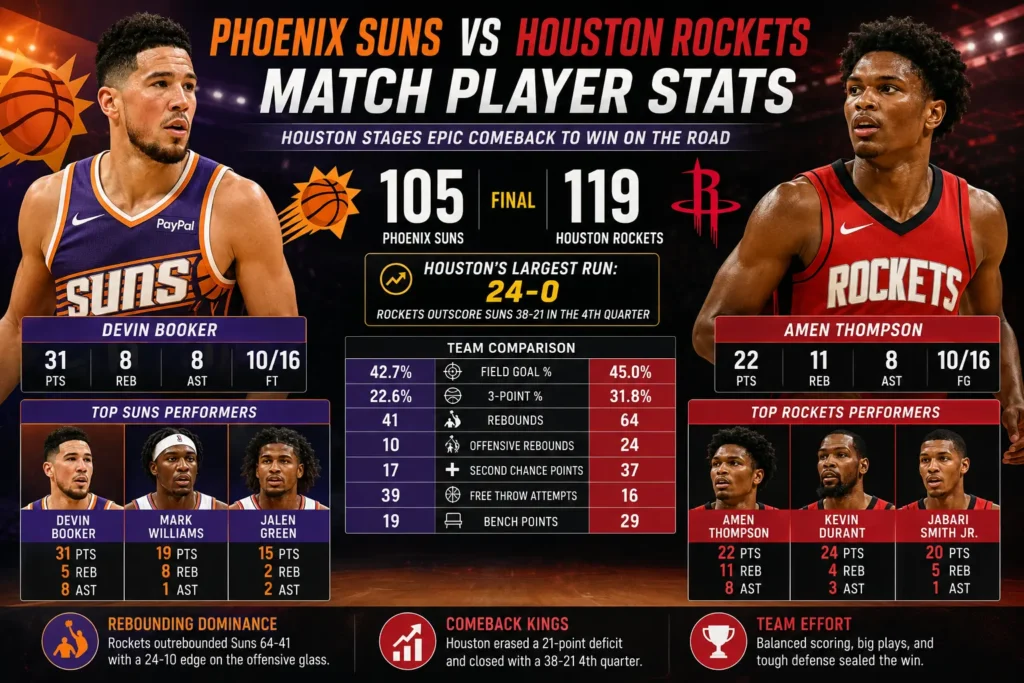
Final score: Houston Rockets 119, Phoenix Suns 105
The opening quarter belonged entirely to Phoenix, who jumped out 37-21 and built a lead as large as 21 points early in the game. But Houston answered with a stronger second quarter, took full control in the third, and blew the game open with a dominant 38-21 fourth quarter to close it out. The swing was significant enough that Houston’s largest run included a 24-0 unanswered stretch at one point in the game — an extraordinary turnaround from where things stood after the first 12 minutes.
Full Box Score Breakdown
Team Totals
Houston shot 45% from the field compared to Phoenix’s 42.7%, but the real separation came on the glass and at the free-throw line in a different way than usual — Phoenix actually shot more free throws overall (39 attempts to Houston’s 16), yet Houston dominated the boards 64-41, including a massive 24-10 edge in offensive rebounds. That rebounding advantage translated directly into a 37-17 gap in second-chance points, a huge share of Houston’s overall offensive output.
Amen Thompson’s Near Triple-Double
The standout individual performance belonged to Amen Thompson, who exploded for 22 points on efficient 10-of-16 shooting, adding 11 rebounds and 8 assists for a double-double that fell just short of a triple-double. His 20 points in the paint reflected an aggressive, downhill attacking style that Phoenix struggled to contain throughout the second half.
Devin Booker’s Elite Scoring Wasn’t Enough
Devin Booker was brilliant in the loss, scoring a game-high 31 points on 7-of-16 shooting, drawing an incredible 10 fouls and going 15-of-16 from the free-throw line. He added 8 assists as well, but even that level of individual production couldn’t offset Houston’s dominance on the glass and Phoenix’s own shooting struggles elsewhere on the roster.
Kevin Durant and Jabari Smith Jr. Provided Scoring Support
Kevin Durant added 24 points on 8-of-20 shooting, including 5-of-9 from three-point range, while Jabari Smith Jr. chipped in 20 points despite a rougher shooting night at 6-of-18. Alperen Sengun’s stat line looked unusual for him — just 12 points on 33.3% shooting — but he still managed a double-double with 14 rebounds (7 offensive) and 6 assists, showing his impact went well beyond scoring that particular night.
Phoenix’s Supporting Cast Struggled to Keep Pace
Mark Williams was efficient for Phoenix with 19 points on 7-of-9 shooting and 8 rebounds, but Jalen Green struggled significantly, managing just 15 points on 35.7% shooting, and Dillon Brooks shot just 3-of-12 for 10 points. With Phoenix’s bench contributing only 19 points compared to Houston’s 29, the disparity in depth became a real factor as the game wore on.
The Turning Point
Houston’s fourth quarter was the definitive stretch, outscoring Phoenix 38-21 to turn what had briefly been a competitive game into a comfortable win. Combined with the 24-0 unanswered run mentioned in the game’s most extreme scoring swing, it’s clear Houston’s response to a rough start was about as complete a turnaround as you’ll see in a single NBA game.
What the Numbers Actually Tell You
Rebounding Was the Story of the Game
Houston’s 64-41 total rebounding advantage, and specifically the 24-10 edge on the offensive glass, was the single biggest factor in the final outcome. Extra possessions off missed shots gave Houston significantly more scoring chances than the raw field goal attempts alone would suggest.
Devin Booker’s Brilliance Couldn’t Overcome Team-Wide Struggles
Booker’s 31-point night, built heavily around drawing fouls and getting to the free-throw line, was a genuinely excellent individual performance. But with Phoenix shooting just 22.6% from three-point range as a team and getting limited bench production, one player’s brilliance wasn’t enough to offset the broader team-wide shooting and depth issues.
Houston’s Depth Made the Difference in the Final Frame
Beyond Thompson’s near triple-double, Houston got real contributions from Reed Sheppard and Aaron Holiday off the bench, giving the Rockets enough scoring balance to pull away decisively once Phoenix’s shooting cooled in the second half.
Common Mistakes When Reading Stats From a Game Like This
- Judging the game purely off the first-quarter score. Phoenix’s 37-21 opening quarter looked like the start of a blowout in their favor, but checking the full quarter-by-quarter breakdown reveals a completely different story by the final buzzer.
- Overlooking rebounding differentials in favor of shooting percentages. Houston’s field goal percentage edge over Phoenix was relatively modest, but the massive rebounding gap, especially on the offensive glass, was the much bigger factor in the final result.
- Assuming a player’s counting stats always reflect their shooting efficiency. Alperen Sengun’s double-double looked productive on the surface, but his shooting percentage that specific night was well below his usual standard — checking shooting splits alongside rebounds and assists gives a fuller picture.
- Ignoring free-throw attempt discrepancies. Phoenix actually attempted far more free throws than Houston in this game, which is easy to miss when the final score favored Houston so clearly.
Best Practices for Following Games Like This
- Check the full quarter-by-quarter scoring breakdown rather than assuming an early lead predicts the final outcome.
- Look at rebounding totals, especially offensive rebounds and second-chance points, for games decided by a wide final margin.
- Use official sources like NBA.com or Basketball-Reference for verified box scores rather than relying on secondhand recaps.
- Compare bench scoring alongside starter production to understand how depth factored into a comeback or collapse.
Personal Experience
I tuned into this game partway through the first quarter and, based purely on the early score, assumed I was about to watch a fairly one-sided Phoenix win. Devin Booker was cooking from the opening tip, and a 37-21 first quarter on the road is the kind of start that usually sets the tone for the rest of the game. Coming back to check the score later and finding Houston up comfortably was a genuine surprise until I actually dug into the full box score.
What stood out most once I looked at the numbers closely was the rebounding gap. A 24-10 offensive rebounding advantage is enormous, and it explained a lot about how Houston was able to completely flip the game’s momentum despite Phoenix getting an outstanding individual performance from Booker. It reinforced something I’ve come to rely on more when reading box scores from games with a big final margin: the shooting percentages get the most attention, but rebounding differentials, especially on the offensive glass, often tell the real story of how a game actually swung.
The other thing that stuck with me was Sengun’s stat line. A double-double with 14 rebounds and 6 assists looks solid at a glance, but the 33.3% shooting on 15 attempts was a genuinely rough shooting night by his standards. It was a good reminder to check shooting efficiency alongside counting stats rather than assuming a double-double automatically means a great overall game — Sengun’s rebounding and playmaking carried real value even on an off night from the field, but that nuance only shows up if you look past the box score’s headline numbers.
FAQs
1. What was the final score when the Suns played the Rockets in 2026? Houston won 119-105 on the road, overcoming a 21-point first-quarter deficit to Phoenix and pulling away with a dominant fourth quarter.
2. Who had the best individual performance in the Suns-Rockets game? Amen Thompson led Houston with 22 points, 11 rebounds, and 8 assists, falling just short of a triple-double. Devin Booker led all scorers with 31 points for Phoenix in the loss.
3. How did Houston come back from such a big early deficit? Houston dominated the rebounding battle, particularly on the offensive glass with a 24-10 advantage, which fueled a huge scoring swing including a 24-0 unanswered run at one point in the game.
4. Why did Alperen Sengun only score 12 points despite a strong overall stat line? Sengun shot just 33.3% from the field that game, well below his usual efficiency, but still managed a double-double with 14 rebounds and 6 assists, showing his impact extended beyond scoring.
5. Where can I find the official box score for this game? Verified box scores and game logs are available through NBA.com’s official stats section and Basketball-Reference, both of which track official league data for every regular-season game.
Conclusion
The Phoenix Suns vs Houston Rockets matchup in 2026 was a genuine tale of two halves — Phoenix dominated the opening quarter behind an outstanding Devin Booker performance, only for Houston’s rebounding advantage and depth to completely reverse the game’s momentum by the final buzzer. Amen Thompson’s near triple-double anchored the comeback, while Alperen Sengun’s double-double, despite an inefficient shooting night, showed how much value a player can provide even when their shot isn’t falling. The clearest lesson from this specific box score is that first-quarter dominance doesn’t guarantee anything in a 48-minute game, especially against a team that controls the boards this decisively.
Actionable takeaways:
- Check the full quarter-by-quarter scoring flow rather than judging a game solely by an early lead.
- Weigh rebounding and second-chance point differentials heavily when evaluating what actually decided a game with a significant final margin.
- Look at shooting efficiency alongside rebounds and assists to properly evaluate a double-double performance.
- Use verified official sources for box score data rather than relying on secondhand recaps.
For further reading on this matchup and the surrounding 2026 NBA season, see ESPN’s NBA coverage, The Athletic’s in-depth NBA analysis, and Cleaning the Glass’s advanced NBA statistics and shot-quality breakdowns.
If you’re following sports storylines like this alongside your regular news reading, Dailynewstime is worth a look for broader daily coverage.
Disclaimer: This article is for general informational purposes only and reflects publicly available statistics current as of the time of writing. Player stats and game results are accurate as of the time of writing — always check official sources like NBA.com for the most current data. This content is not affiliated with or endorsed by the NBA, the Phoenix Suns, or the Houston Rockets.