
Introduction
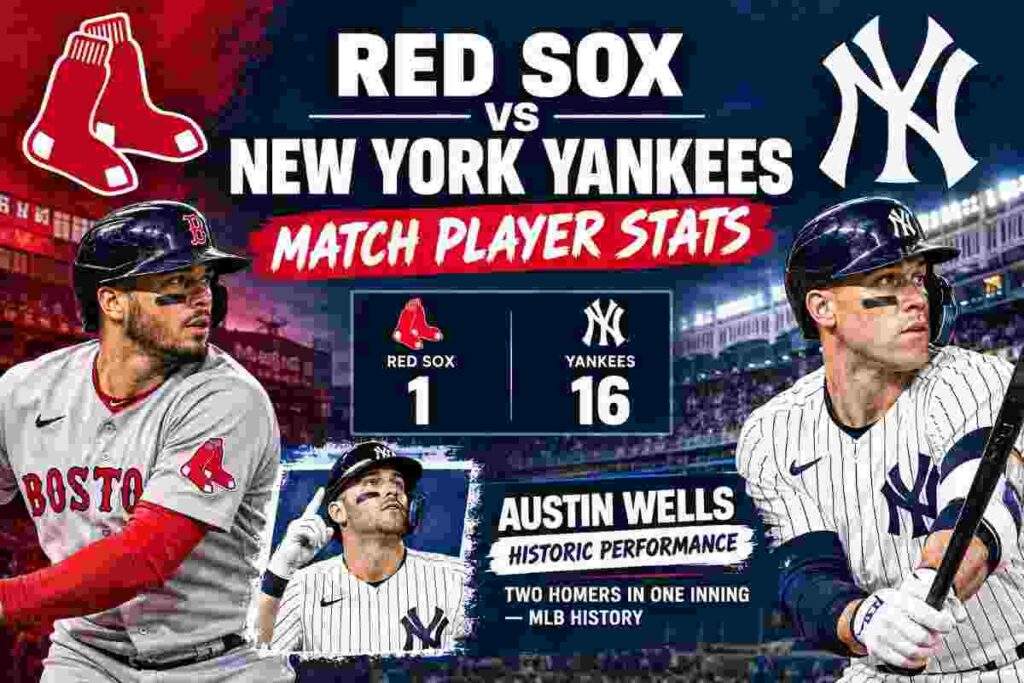
Few rivalries in American sports carry the weight of Red Sox vs Yankees, and their August 30, 2026 meeting at Yankee Stadium delivered a genuinely historic moment on top of the usual intensity. New York routed Boston 16-1, clinching the regular-season series, and did it behind a nine-run eighth inning that included a piece of MLB history nobody saw coming from a player who wasn’t even in the starting lineup.
If you’re searching for Red Sox vs New York Yankees match player stats, this breakdown covers the full box score from this lopsided, historic finale, Austin Wells’ record-setting performance, and what the result meant for both teams’ playoff positioning.
The Game at a Glance
New York closed out its four-game series against Boston in dominant fashion:
Final score: New York Yankees 16, Boston Red Sox 1
The win completed a 3-1 series victory for New York and, more significantly, clinched the season series against Boston, with the Yankees finishing 7-6 against the Red Sox across their 13 meetings in 2026. That result matters beyond bragging rights — it gives New York the tiebreaker if the two teams finish the season with identical records, a genuinely meaningful edge in a tight AL Wild Card race. The win pushed the Yankees to 78-59, four games clear of Boston (74-63) for the top AL Wild Card spot.
Full Box Score Breakdown
The Game Stayed Scoreless Into the Fifth
Boston starter Ranger Suarez kept the Yankees off the board through four innings before everything unraveled. A disputed play at the top of the fifth — where Ceddanne Rafaela’s glove was ruled to have touched the grass on what looked like a caught liner from Jazz Chisholm Jr., turning it into a hit rather than an out — opened the door for New York’s offense, and the Yankees didn’t look back.
Paul Goldschmidt and Heliot Ramos Broke It Open
Paul Goldschmidt delivered a two-run single during New York’s five-run fifth inning, part of a 3-RBI day that also included a home run later in the game. Heliot Ramos followed with a three-run homer in that same fifth inning — his first home run since being acquired from San Francisco at the trade deadline, and his first multi-hit game in a Yankees uniform after entering the day just 7-for-59 in his first 20 games with the team.
Austin Wells Makes MLB History
The defining moment of the game came in the eighth inning. Austin Wells, who wasn’t even in New York’s starting lineup, entered as a pinch-hitter and hit two home runs in the same inning — becoming the first player in MLB history to enter a game as a pinch-hitter and then hit multiple home runs in a single frame. Wells finished with 5 RBIs on the day. His first homer came off reliever Jovani Moran, and his second came against a position player, infielder Andruw Monasterio, who was pitching in relief by that point in the blowout. Wells became just the seventh Yankee ever to homer twice in a single inning, and the first since Gleyber Torres accomplished the feat in September 2022.
Jose Caballero Also Delivered a Big Blow
Jose Caballero, starting at shortstop in place of rookie George Lombard Jr. (out with right knee discomfort), also connected for a three-run home run during New York’s historic eighth inning, adding to what became a nine-run frame built on four total home runs.
Boston’s Lone Run
Nick Sogard drove in Boston’s only run of the game with an RBI single in the eighth inning, one of just six hits Boston starter-turned-reliever Will Warren allowed across more than seven innings of work in earning the win. Roman Anthony had opened the scoring chances early with a ground-rule double in the first inning, but Boston’s offense never found any real traction against New York’s pitching.
Team Totals
New York finished with 18 hits, its second-highest total of the season, while scoring 16 runs — their most in any game in 2026. Suarez, Boston’s starter, allowed season-high totals of 6 runs and 9 hits across 5⅓ innings, with reliever Andruw Monasterio surrendering 5 more runs in relief.
What the Numbers Actually Tell You
One Inning Defined the Entire Game
The eighth inning alone accounted for 9 of New York’s 16 runs and featured 4 home runs, turning what had been a competitive pitching duel through four innings into one of the most lopsided results of the season for either team. That kind of inning-specific collapse is a good reminder that a final score doesn’t always reflect how a game actually unfolded pitch by pitch.
A Disputed Replay Review Was the Turning Point
The overturned defensive play in the fifth inning, where a would-be spectacular catch was ruled a trapped ball, was the moment the game’s entire complexion changed. Boston challenged and lost, and New York capitalized immediately with a five-run inning that set the tone for everything that followed.
Wells’ Performance Was Genuinely Unprecedented
Beyond just being a big offensive game, Wells accomplishing something no player in MLB history had done before — entering as a pinch-hitter and homering twice in the same inning — is the kind of stat line that stands out even in a sport with over a century of recorded history.
Common Mistakes When Reading Stats From a Blowout Like This
- Assuming a lopsided score means the game was one-sided throughout. This game was scoreless through four innings before a nine-run eighth inning completely changed the final numbers — always check the inning-by-inning breakdown for the real story.
- Overlooking bench and reserve players’ contributions. Austin Wells wasn’t even in the starting lineup, and his pinch-hit performance ended up being the single biggest storyline of the entire game.
- Ignoring the context of a disputed or overturned call. The fifth-inning replay review was a genuine inflection point in this specific game, not just a footnote — plays like that can meaningfully shift a game’s entire outcome.
- Treating season series results as just a formality. The Yankees clinching the 7-6 season series edge over Boston has real playoff-seeding implications given MLB’s tiebreaker rules, not just historical bragging rights.
Best Practices for Following Games Like This
- Check inning-by-inning scoring breakdowns rather than relying solely on the final score to understand how a lopsided game actually developed.
- Pay attention to which players entered off the bench, since pinch-hit and relief appearances can turn into the defining storyline of a game.
- Use official sources like MLB.com or Baseball-Reference for verified box scores rather than relying on secondhand recaps.
- Track season series results between division or wild-card rivals specifically, since tiebreaker implications can matter significantly late in a season.
Personal Experience
I caught the tail end of this game live, tuning in right as the broadcast cut to the bottom of the eighth inning, and had no idea going in that I was about to watch actual baseball history. Watching Austin Wells step in as a pinch-hitter and immediately go deep was exciting enough on its own, but seeing him come up again later in that same inning and do it a second time was the kind of moment that made the broadcast booth’s excitement feel completely earned rather than manufactured hype.
What surprised me going back through the full game afterward was how quiet the first four innings actually were. I’d assumed, based on the eventual 16-1 final score, that this had been a blowout from the opening pitch, and instead found a genuinely tight, scoreless pitcher’s duel that only unraveled after a disputed replay review in the fifth. That’s a good reminder that final scores in baseball, maybe more than in any other sport, can completely obscure how competitive a game actually was for long stretches before one inning changes everything.
The other thing that stuck with me was checking just how unusual Wells’ feat actually was in the context of Yankees history specifically. Learning that he was only the seventh player in franchise history to homer twice in a single inning, and the first since 2022, gave real weight to what could have otherwise just registered as “big offensive day” if I hadn’t dug into the historical context. It’s a good habit to check how a specific performance stacks up historically, not just within the context of that one game.
FAQs
1. What was the final score of this Red Sox vs Yankees game? The New York Yankees won 16-1, clinching a 3-1 series victory and the overall 2026 season series against Boston with a 7-6 record across their 13 meetings.
2. What made Austin Wells’ performance historic? Wells became the first player in MLB history to enter a game as a pinch-hitter and then hit two home runs in the same inning, finishing with 5 RBIs. He was also the first Yankee to homer twice in an inning since Gleyber Torres in 2022.
3. Why did the season series result matter for these two teams? The Yankees clinching the head-to-head season series against Boston gives New York the tiebreaker if both teams finish the 2026 season with identical records, which carries real weight in a tight AL Wild Card race.
4. Who else had standout performances in this game for New York? Heliot Ramos hit a three-run homer in his first multi-hit game as a Yankee since being traded from San Francisco, Paul Goldschmidt drove in 3 runs including a home run, and Jose Caballero added a three-run homer while filling in at shortstop.
5. Where can I find the official box score for this game? Verified box scores and game logs are available through MLB.com’s official Gameday section and Baseball-Reference, both of which track official league data for every game.
Conclusion
These Red Sox vs New York Yankees match player stats tell the story of a game that stayed scoreless for four innings before completely unraveling for Boston, capped by Austin Wells’ genuinely unprecedented pinch-hit, multi-homer eighth inning. Beyond the historic individual moment, New York’s series and season series wins carry real tiebreaker implications heading into a tight AL Wild Card race, making this far more than just a lopsided box score in an already storied rivalry.
Actionable takeaways:
- Check inning-by-inning scoring breakdowns to understand how a lopsided final score actually developed.
- Pay attention to bench and pinch-hit performances, since they can become the defining storyline of a game.
- Track season series results between rivals for their real playoff tiebreaker implications.
- Use verified official sources for box score data rather than relying on secondhand recaps.
For further reading on this game and the surrounding 2026 MLB season, see ESPN’s MLB coverage, The Athletic’s in-depth Red Sox and Yankees analysis, and FanGraphs’ advanced sabermetric statistics and analysis.
If you’re following MLB storylines like this alongside your regular news reading, Dailynewstime is worth a look for broader daily coverage.
Disclaimer: This article is for general informational purposes only and reflects publicly available statistics current as of the time of writing. Player stats and standings may be updated as the season progresses — always check official sources like MLB.com for the most current data. This content is not affiliated with or endorsed by MLB, the Boston Red Sox, or the New York Yankees.