
Introduction
Victor Wembanyama posting a triple-double is impressive on its own. Victor Wembanyama posting a triple-double built around 12 blocks, in a playoff game, and still losing? That’s the kind of stat line that demands a closer look. Game 1 of the 2026 Western Conference Semifinals between the Minnesota Timberwolves and San Antonio Spurs delivered exactly that — a tight, physical battle that came down to a strong Minnesota fourth quarter.
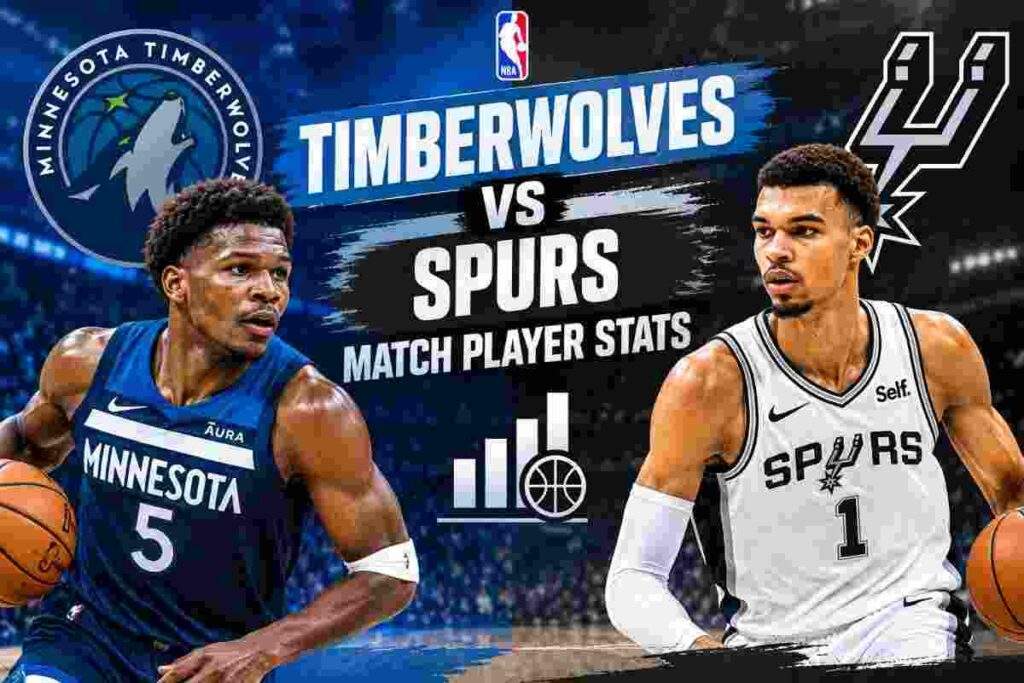
If you’re searching for Timberwolves vs San Antonio Spurs match player stats, this breakdown covers the full Game 1 box score, Wembanyama’s historically unusual triple-double, and how Minnesota managed to steal a road win despite San Antonio’s superstar dominating the defensive end.
The Game at a Glance
Minnesota opened the series with a road win at San Antonio’s home floor:
Final score: Minnesota Timberwolves 104, San Antonio Spurs 102
The game was tight throughout, with neither team building more than a modest lead — San Antonio’s biggest advantage reached just 7 points, while Minnesota’s peak lead was 9. Minnesota’s fourth quarter was the difference, outscoring San Antonio 35-30 to close out a game that stayed competitive down to the final possessions.
Full Box Score Breakdown
Victor Wembanyama’s Historically Unusual Triple-Double
The headline performance of the night belonged to Victor Wembanyama, who recorded a triple-double with 11 points, 15 rebounds, and an extraordinary 12 blocks — a stat line built almost entirely around defensive dominance rather than scoring. His shooting was inefficient on the night, going just 5-of-17 from the field, but his rim protection and rebounding presence were still enough to fundamentally shape how the game was played, evident in Minnesota shooting only 54.3% at the rim against San Antonio’s interior length.
Dylan Harper and Stephon Castle Carried San Antonio’s Scoring
With Wembanyama’s own scoring limited, San Antonio’s offense leaned on its guards. Dylan Harper led all Spurs scorers with 18 points on an efficient 7-of-13 shooting, while Stephon Castle added 17 points on 4-of-8 shooting, including 3-of-5 from three-point range and a strong 6-of-8 mark from the free-throw line.
De’Aaron Fox and Julian Champagnie Rounded Out the Effort
De’Aaron Fox struggled offensively, managing just 10 points on 5-of-14 shooting with 6 turnovers against only 6 assists, a genuinely rough efficiency night for San Antonio’s veteran guard. Julian Champagnie was a bright spot off the bench, adding 17 points on an efficient 7-of-12 shooting, including 3-of-7 from three-point range.
Julius Randle and Anthony Edwards Led Minnesota’s Response
Julius Randle led Minnesota with 21 points and 10 rebounds for a double-double, though he needed 20 shot attempts to get there, reflecting a somewhat inefficient but high-volume night. Anthony Edwards was considerably more efficient, scoring 18 points on 8-of-13 shooting, including 2-of-3 from three-point range.
Minnesota’s Role Players Made the Difference
Jaden McDaniels added 16 points on 7-of-14 shooting, Terrence Shannon Jr. contributed 16 points off the bench, and Rudy Gobert quietly posted a double-double with 7 points and 10 rebounds while adding 4 steals defensively. Mike Conley’s 12 points on 4-of-8 shooting, including 4-of-7 from three-point range, provided timely floor-spacing off the bench.
Team Totals Reveal the Real Story
San Antonio actually shot slightly better as a team (44.8% to Minnesota’s 45.6% is close, but San Antonio’s 27.8% from three-point range badly lagged Minnesota’s 38.5%). San Antonio also generated more fast-break points (27 to Minnesota’s 10) and out-blocked Minnesota’s already-strong shot-blocking with a combined 14 blocks, largely thanks to Wembanyama. But Minnesota’s offensive rebounding (12 to San Antonio’s 13, close but slightly better positioned) and free-throw attempts (21 to San Antonio’s 18) helped offset San Antonio’s transition scoring advantage.
What the Numbers Actually Tell You
A Triple-Double Doesn’t Always Mean a Win
Wembanyama’s stat line is a genuinely rare example of a player completely controlling the defensive and rebounding aspects of a game — 12 blocks in a single game is an enormous number by any standard — while his team still lost. It’s a strong reminder that even historically unusual individual dominance in one facet of the game doesn’t guarantee the final result.
San Antonio’s Three-Point Shooting Was the Real Problem
At just 27.8% from three-point range as a team, San Antonio’s perimeter shooting was the clearest statistical gap in the game, especially compared to Minnesota’s much stronger 38.5% clip. In a game decided by 2 points, that shooting differential was arguably more consequential than any single player’s individual performance.
Minnesota’s Fourth-Quarter Composure Sealed It
Outscoring San Antonio 35-30 in the fourth quarter of a road playoff game, against a defense anchored by one of the league’s most dominant shot-blockers, speaks to real poise from Minnesota’s supporting cast down the stretch.
Common Mistakes When Reading Stats From a Game Like This
- Assuming a triple-double always reflects a winning performance. Wembanyama’s game is a clear counterexample — dominant individual stats in specific categories don’t automatically translate into a team win, especially when shooting efficiency elsewhere on the roster lags.
- Overlooking team-wide three-point shooting splits. A 2-point final margin makes San Antonio’s 27.8% three-point shooting easy to miss, but it was arguably the single biggest factor separating the two teams.
- Ignoring turnover-heavy stat lines buried in decent scoring totals. De’Aaron Fox’s 10 points with 6 turnovers against just 6 assists was a genuinely difficult night for San Antonio’s primary ball-handler, even though the raw scoring total doesn’t scream “rough game.”
- Judging role players purely by scoring volume. Rudy Gobert’s modest 7 points undersold his actual defensive and rebounding impact, reflected far more accurately in his double-double and 4 steals.
Best Practices for Following Games Like This
- Check team-wide shooting splits, especially from three-point range, when trying to understand what actually decided a close game.
- Look past headline individual stat lines like a triple-double to see whether the underlying efficiency supported winning basketball.
- Use official sources like NBA.com or Basketball-Reference for verified box scores rather than relying on secondhand recaps.
- Track fourth-quarter or closing-stretch scoring specifically in close playoff games, since that’s often where composure and depth matter most.
Personal Experience
I went back to this box score specifically because I’d heard about Wembanyama’s block total and wanted to see it in the context of an actual final result. Twelve blocks in a single game is the kind of number that sounds almost like a typo the first time you see it, and confirming it directly in the box score made it clear this wasn’t an exaggeration — it was a genuinely dominant defensive performance.
What made it more interesting, though, was realizing San Antonio still lost. That combination — a player controlling the paint and the glass to that degree, while his team comes up two points short — was a good reminder that basketball really is a five-person game, and that no single statistical category, however extreme, guarantees a result on its own. Checking the team-wide three-point shooting numbers afterward made the loss make a lot more sense: San Antonio simply couldn’t buy a shot from outside, while Minnesota was hitting at a significantly higher clip.
The other thing that stuck with me was De’Aaron Fox’s stat line. Ten points with six turnovers is a genuinely rough offensive night for a player of his caliber, and it was easy to miss amid the bigger storyline around Wembanyama’s defensive numbers. It reinforced something I try to do now with any close playoff box score: check every significant contributor’s efficiency, not just the headline performer, because close games are often decided by which team’s role players and secondary stars have the better night, not just the star matchup everyone’s watching.
FAQs
1. Who won Game 1 of the Timberwolves-Spurs series? The Minnesota Timberwolves won 104-102 on the road, closing out a tight game with a strong 35-30 fourth quarter.
2. What made Victor Wembanyama’s performance in this game so unusual? Wembanyama recorded a triple-double with 11 points, 15 rebounds, and 12 blocks — an extraordinarily high block total that reflected complete defensive dominance, even though San Antonio still lost the game.
3. Who led San Antonio in scoring in this game? Dylan Harper led the Spurs with 18 points on efficient shooting, while Stephon Castle and Julian Champagnie each added 17 points.
4. What was the biggest factor in Minnesota’s win? San Antonio’s poor three-point shooting (27.8% as a team, compared to Minnesota’s 38.5%) combined with Minnesota’s composed fourth quarter were the clearest factors in a game decided by just 2 points.
5. Where can I find the official box score for this game? Verified box scores and game logs are available through NBA.com’s official stats section and Basketball-Reference, both of which track official league data for every playoff game.
Conclusion
These Timberwolves vs San Antonio Spurs match player stats from Game 1 tell a genuinely unusual story: one of the most dominant individual defensive performances in recent memory, Victor Wembanyama’s 11-15-12 triple-double, still wasn’t enough to prevent a road loss, largely because San Antonio’s supporting cast struggled from three-point range while Minnesota’s role players delivered in the fourth quarter. It’s a strong reminder that even historically rare individual stat lines don’t tell the whole story of how a close playoff game actually gets decided.
Actionable takeaways:
- Check team-wide shooting splits, especially from three-point range, to understand what really decided a close game.
- Don’t assume a triple-double or dominant individual stat line automatically means a winning performance.
- Look at every significant contributor’s efficiency, not just the headline performer, in a tight playoff game.
- Use verified official sources for box score data rather than relying on secondhand recaps.
For further reading on this series and the surrounding 2026 playoffs, see ESPN’s NBA playoff coverage, The Athletic’s in-depth playoff analysis, and Cleaning the Glass’s advanced NBA statistics and shot-quality breakdowns.
If you’re following NBA storylines like this alongside your regular news reading, Dailynewstime is worth a look for broader daily coverage.
Disclaimer: This article is for general informational purposes only and reflects publicly available statistics from the 2026 NBA playoffs. Player stats and game results are accurate as of the time of writing — always check official sources like NBA.com for the most current data. This content is not affiliated with or endorsed by the NBA, the Minnesota Timberwolves, or the San Antonio Spurs.