
Introduction
Few young centers in the NBA have put together a statistical progression as steady and interesting to track as Alperen Sengun. Drafted 16th overall in 2021 and immediately dealt to the Houston Rockets on draft night, Sengun has developed from a raw, skilled rookie into a two-time All-Star with career-high numbers across nearly every major statistical category. Looking at his stats year by year tells a genuinely compelling story of a player figuring out exactly what kind of center he wants to be.
If you’re searching for Alperen Sengun stats — whether for fantasy research, general curiosity, or comparison purposes — this guide breaks down his full career averages, season-by-season progression, key career highs, and what the numbers actually reveal about his development.
Alperen Sengun’s Career Averages
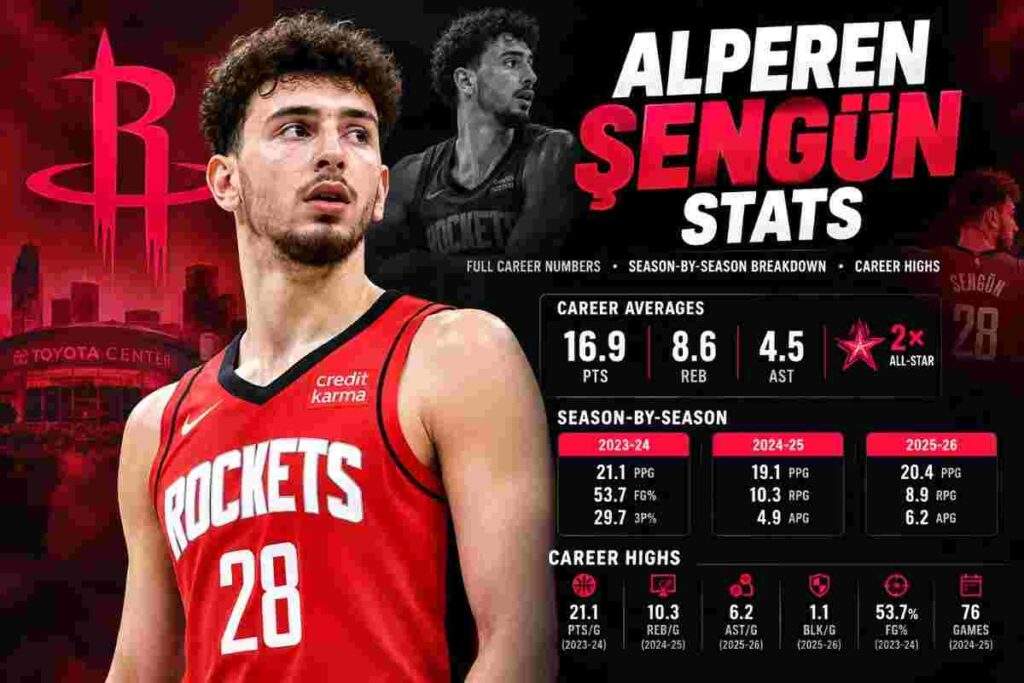
Across five NBA seasons and 358 regular-season games, Sengun has averaged approximately 16.9 points, 8.6 rebounds, and 4.5 assists per game, with two career All-Star selections to his name. Those blended career numbers, however, understate just how much his production has grown since his rookie season — his most recent full seasons look dramatically different from his early career averages.
Background and Basic Profile
Sengun was born on July 25, 2002, in Giresun, Turkey, and stands 6-foot-11, listed at 243 pounds. He came up through Turkish basketball, playing for Bandırma Kırmızı, Teksüt Bandırma, and Beşiktaş before entering the 2021 NBA Draft, where the Oklahoma City Thunder selected him 16th overall before immediately trading his rights to Houston. He’s continued representing the Turkish national team throughout his NBA career, and goes by the nickname “Alpy” among teammates and fans.
Season-by-Season Stats Breakdown
2023-24: The Breakout Efficiency Season
Sengun’s 2023-24 campaign is widely regarded as his breakout year from an efficiency standpoint. He posted a career-high 21.1 points per game, shooting an excellent 53.7% from the field and 29.7% from three-point range — numbers that established him as a legitimately elite offensive center rather than just a promising young prospect.
2024-25: Rebounding and Durability Career Highs
The following season, Sengun earned his first career All-Star selection, averaging 19.1 points, a career-high 10.3 rebounds, and 4.9 assists per game. He also set a career high in games played, appearing in 76 contests that season. His shooting efficiency dipped notably, though — he shot below 50% from the field for the first time since his rookie season, and posted a career-low 23.3% from three-point range.
2025-26: A More Well-Rounded All-Star Campaign
Sengun’s most recent full season saw him earn his second consecutive All-Star nod, averaging 20.4 points, 8.9 rebounds, and a career-high 6.2 assists per game, along with 1.2 steals and a career-high 1.1 blocks per game across 72 appearances. His shooting rebounded significantly from the previous season’s dip, climbing to 51.9% from the field and 30.5% from three, while his free-throw percentage held steady at 69.1%.
Career Highs at a Glance
| Category | Career High | Season |
|---|---|---|
| Points per game | 21.1 | 2023-24 |
| Rebounds per game | 10.3 | 2024-25 |
| Assists per game | 6.2 | 2025-26 |
| Blocks per game | 1.1 | 2025-26 |
| Field goal percentage | 53.7% | 2023-24 |
| Games played | 76 | 2024-25 |
What the Season-by-Season Trend Actually Shows
A Genuine Playmaking Evolution
The steady climb in Sengun’s assist numbers — reaching a career-high 6.2 per game in 2025-26 — reflects real, sustained development rather than a single standout season. For a player his size, that level of consistent playmaking growth is a meaningful part of what separates him from a more traditional back-to-the-basket center archetype.
Three-Point Shooting Has Been the Most Volatile Category
Sengun’s three-point percentage has swung significantly year to year — from a solid 29.7% in his breakout 2023-24 season, down to a career-low 23.3% the following year, before rebounding to 30.5% in 2025-26. That volatility is worth watching going forward, since consistent perimeter shooting from a center of his size and skill set would meaningfully expand his offensive impact.
Rebounding and Scoring Have Traded Off Depending on Role
Interestingly, Sengun’s rebounding and scoring numbers haven’t necessarily peaked in the same season — his best rebounding year (2024-25) came with a scoring dip from his breakout efficiency season the year before, suggesting his role and offensive usage have shifted somewhat depending on Houston’s overall roster construction each season.
Common Mistakes When Reading a Player’s Career Stats
- Relying only on blended career averages. A player’s full-career averages can understate genuine recent development — Sengun’s 16.9 career points-per-game average is meaningfully lower than his last three individual seasons, which have all been well above that mark.
- Ignoring efficiency alongside counting stats. A season with strong scoring or rebounding totals can still reflect a shooting efficiency dip, as seen in Sengun’s 2024-25 season — always check shooting percentages alongside raw per-game numbers.
- Assuming career highs all happened in the same season. As the table above shows, Sengun’s individual career highs are actually spread across three different seasons, not concentrated in a single standout year.
- Overlooking games played as a stat worth tracking. Durability matters for overall value, and Sengun’s career-high 76 games played in 2024-25 is a meaningful data point alongside his per-game production numbers.
Best Practices for Tracking Sengun’s Stats Going Forward
- Check season-specific stats rather than relying solely on blended career averages, especially for a player whose production has changed significantly year to year.
- Watch his three-point percentage specifically as an indicator of continued offensive growth, given how much it’s fluctuated across recent seasons.
- Track assist-to-turnover ratio alongside his growing assist numbers, since an expanded playmaking role also comes with added risk.
- Use official, verified sources like NBA.com, ESPN, or Basketball-Reference for the most current and accurate statistics.
Personal Experience
I started tracking Sengun’s stats closely after his 2023-24 breakout season, when the jump to 21.1 points per game on nearly 54% shooting genuinely caught my attention as a signal that Houston had something special developing at center. What surprised me the following season was how much his shooting efficiency actually dipped even as his rebounding hit a career high — it wasn’t the smooth, linear improvement I’d expected after such a strong efficiency season the year before.
That inconsistency taught me something useful about how I read young players’ statistical progressions now: development rarely happens as a straight line across every category simultaneously. Sengun’s rebounding peaked in a season where his scoring and shooting efficiency actually regressed, which is a good reminder that a player can genuinely improve in real, meaningful ways in one area while taking a step back in another during the same season.
The other thing that stood out digging into his full season-by-season numbers was just how much his career averages undersell his current level of play. Looking only at his blended career stats — 16.9 points, 8.6 rebounds, 4.5 assists — you’d get a picture of a solid but unspectacular player, when in reality his last two full seasons have both been legitimate All-Star campaigns well above those career figures. It’s a good reminder to always check season-specific numbers rather than leaning on career averages alone when trying to understand a player’s current level.
FAQs
1. What is Alperen Sengun’s career scoring average? Across his NBA career, Sengun has averaged approximately 16.9 points per game, though his individual season averages in his most recent three years have all been significantly higher, ranging from 19.1 to 21.1 points per game.
2. What is Alperen Sengun’s career-high in points per game for a season? His career-high scoring average for a single season is 21.1 points per game, set during the 2023-24 season.
3. How many All-Star selections does Alperen Sengun have? Sengun has been selected to two NBA All-Star Games, first in 2024-25 and again in 2025-26.
4. What is Alperen Sengun’s best rebounding season? His career-high rebounding average came in the 2024-25 season, when he averaged 10.3 rebounds per game.
5. Has Alperen Sengun’s three-point shooting improved over his career? It’s been inconsistent — he shot 29.7% from three in his 2023-24 breakout season, dropped to a career-low 23.3% the following year, and rebounded to 30.5% in 2025-26, making it one of the more volatile parts of his statistical profile.
Conclusion
Alperen Sengun’s stats tell the story of a player who’s continued to evolve in different directions across different seasons rather than following a single, predictable improvement curve. From his efficiency-driven breakout in 2023-24 to his rebounding peak in 2024-25 and his playmaking and shot-blocking career highs in 2025-26, each season has added a genuinely new dimension to his overall game. For anyone trying to understand his current level of play, his last three individual seasons offer a far more accurate picture than his blended career averages alone.
Actionable takeaways:
- Look at season-specific stats rather than career averages alone to understand a player’s current form.
- Track shooting efficiency alongside counting stats for a complete picture of a given season.
- Watch three-point shooting specifically as a key indicator of Sengun’s continued offensive development.
- Use verified official sources for the most accurate and up-to-date career statistics.
For further reading, see ESPN’s full career stats for Alperen Sengun, Basketball-Reference’s detailed career and season statistics database, and NBA.com’s official player profile and career recaps.
If you’re following NBA storylines like this alongside your regular news reading, Dailynewstime is worth a look for broader daily coverage.
Disclaimer: This article is for general informational purposes only and reflects publicly available statistics current as of the time of writing. Career stats and season totals may be updated as new data becomes available — always check official sources like NBA.com or Basketball-Reference for the most current numbers. This content is not affiliated with or endorsed by the NBA, the Houston Rockets, or Alperen Sengun.