
Introduction
Every so often, a player’s development curve and a team’s roster upgrade line up perfectly, and the result is greater than the sum of its parts. That’s exactly what happened with Alperen Sengun and the Houston Rockets in 2026. Already an established All-Star heading into the season, Sengun took another real step forward, aided significantly by the offseason addition of Kevin Durant, and turned Houston into one of the most efficient offenses in basketball.
If you’re searching for information on Alperen Sengun’s 2026 season with the Houston Rockets, whether for fantasy purposes, general fandom, or just catching up on how his game has evolved, this breakdown covers his full statistical season, the Durant partnership that reshaped Houston’s offense, his playoff performance, and what to expect going forward.
Alperen Sengun’s 2025-26 Season by the Numbers
Regular Season Averages
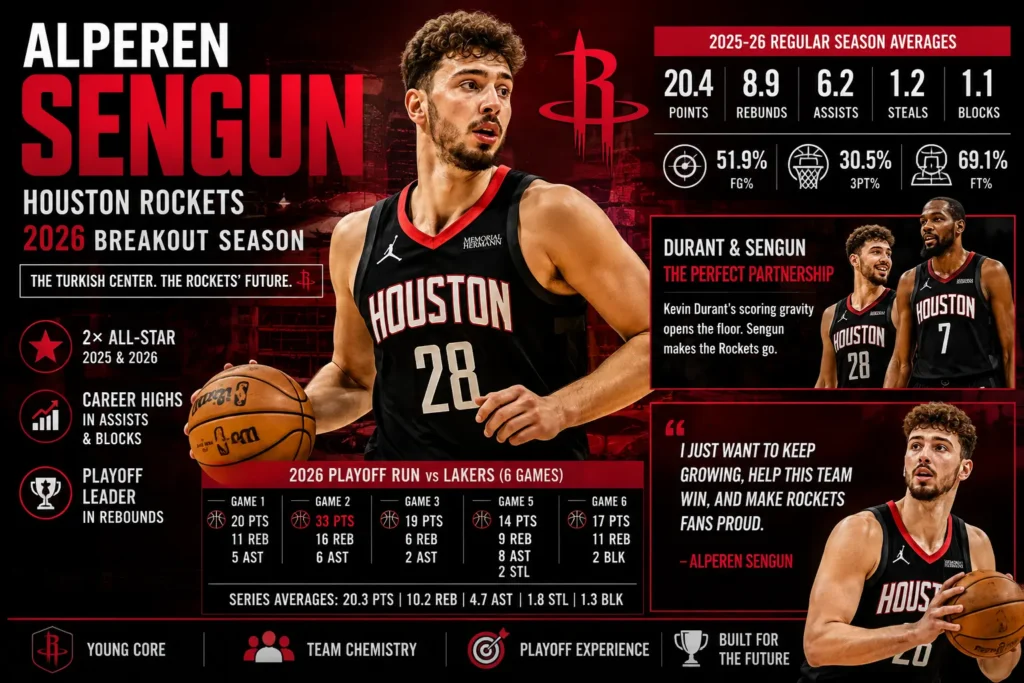
Sengun closed out the 2025-26 regular season averaging 20.4 points, 8.9 rebounds, 6.2 assists, 1.2 steals, and 1.1 blocks in 33.3 minutes per game across 72 appearances. Both his assist and block numbers marked new career-highs for the Turkish center, reflecting his continued growth as a genuine offensive hub rather than just a scoring big man.
His shooting also improved across the board: a 51.9% mark from the field, up from the previous season, along with a notable jump to 30.5% from three-point range — a significant improvement after shooting a career-low 23.3% from deep the year before. His free-throw percentage held steady at 69.1%.
A Hot Start Fueled by the Durant Partnership
Sengun’s numbers looked even more dramatic early in the season before settling into his final averages. Through the first 11 games, with Houston sitting at 8-3 and holding the No. 3 seed in a stacked Western Conference, Sengun was putting up 22.4 points, 10.2 rebounds, and 7.4 assists per game, shooting an efficient 50.3% from the field. That hot start came as Houston’s offense as a whole was leading the NBA in scoring, averaging 125.5 points per game with a league-best 124.5 offensive rating — even with veteran floor general Fred VanVleet out for the season with a torn ACL.
Second Career All-Star Selection
Building on his first All-Star nod the previous season, Sengun earned his second consecutive All-Star selection in 2025-26, cementing his status as one of the league’s premier offensive centers. He also received votes for All-NBA Third Team recognition, though he ultimately fell just short of making the cut.
The Kevin Durant Partnership
Houston’s acquisition of Kevin Durant heading into the 2025-26 season was the single biggest storyline shaping Sengun’s individual production. Durant’s gravity as a scorer opened up spacing and opportunities that simply weren’t available to Houston’s offense in prior seasons, and Sengun benefited directly — both in terms of easier looks and in his own development as Houston’s primary frontcourt facilitator.
Sengun’s role evolved into something distinct within that partnership: rather than needing to carry Houston’s offense alone, he became the connective tissue between Durant’s scoring and the rest of Houston’s young core, particularly Amen Thompson and Jalen Green, both of whom benefited significantly from Sengun’s ability to find cutters from the post given his unusual passing instincts for a 6-foot-11 center.
Alperen Sengun’s 2026 Playoff Run
Houston earned a playoff berth and faced the Los Angeles Lakers in the first round, ultimately falling in six games. Sengun’s individual playoff performance across the series told a story of both genuine production and some real efficiency struggles:
- Game 1: 20 points, 11 rebounds, 5 assists in a loss
- Game 2: 33 points, 16 rebounds, 6 assists — his best individual game of the series
- Game 3: 19 points, 6 rebounds, 2 assists
- Game 5: 14 points, 9 rebounds, a series-best 8 assists, 2 steals in a win
- Game 6: 17 points, 11 rebounds, 2 blocks in the season-ending loss
Across the series, Sengun averaged 20.3 points, 10.2 rebounds, 4.7 assists, 1.8 steals, and 1.3 blocks, leading Houston in rebounding for the series and finishing second on the team in scoring. His efficiency did drop noticeably in the postseason, though that struggle was a broader theme for the Rockets as a team throughout the series against a well-prepared Lakers defense.
What the Numbers Say About Sengun’s Growth
Playmaking Has Become a Real Strength, Not Just a Novelty
Sengun’s assist numbers climbing to a career-high 6.2 per game during the regular season, and peaking at 8 assists in a single playoff game, reflect genuine development rather than a small-sample fluke. For a center his size, that level of consistent playmaking remains relatively rare across the league.
Three-Point Shooting Improvement Adds a New Dimension
The jump from a career-low 23.3% from three the prior season to 30.5% in 2025-26 is a meaningful improvement, even if it’s still an area with room to grow. A center who can credibly space the floor alongside a scorer like Durant adds real value beyond traditional interior scoring and rebounding.
Playoff Efficiency Remains the Next Frontier
Sengun’s counting stats in the playoffs were strong, but his shooting efficiency — reflected in some of the individual game box scores from the series — dipped compared to his regular season standard. That’s consistent with what Houston’s coaching staff and analysts have flagged as the next area for development: performing at an elite efficiency level specifically in high-leverage playoff situations against more focused, game-planned defenses.
Common Mistakes When Evaluating a Season Like This
- Overweighting early-season numbers. Sengun’s stats through his first 11 games were noticeably higher than his final season averages — always check full-season numbers rather than assuming a hot start is fully representative.
- Ignoring shooting efficiency in playoff performances. A player can put up strong counting stats in a playoff series while shooting well below their regular-season percentages — checking field goal and true shooting percentages alongside points and rebounds gives a much fuller picture.
- Crediting or blaming one player in isolation for a playoff loss. Sengun’s efficiency struggles in the playoffs were part of a broader team-wide theme against the Lakers, not an isolated individual issue.
- Overlooking the context of a key roster addition. Sengun’s statistical jump can’t be fully separated from Kevin Durant’s arrival — attributing all of the improvement purely to individual development misses an important piece of the picture.
Best Practices for Following Sengun and the Rockets Going Forward
- Track his three-point percentage specifically as a key development indicator, since it’s the clearest area of recent statistical growth.
- Watch his assist numbers relative to turnovers, since his playmaking role has expanded significantly and comes with added risk.
- Pay attention to how his role evolves alongside Durant into the 2026-27 season, since Houston’s rotation is expected to remain largely intact.
- Use official sources like NBA.com, ESPN, or Basketball-Reference for verified season and career statistics rather than relying on secondhand summaries.
Personal Experience
I started paying closer attention to Sengun’s game specifically after watching a stretch of his early-season performances, where the passing out of the post genuinely stood out compared to how most centers around the league operate offensively. Watching him find cutters like Amen Thompson from the elbow or the low block, with the kind of vision usually associated with guards, was a noticeably different offensive weapon than what most teams get from their starting center.
What surprised me tracking his numbers across the full season was how much his per-game averages settled from that blistering early-season pace. The 22.4 points and 10.2 rebounds through 11 games looked like a genuine leap into a new tier of production, and while his final 20.4 and 8.9 season averages were still excellent and All-Star caliber, it was a good reminder that a hot early stretch, even over a reasonably sized sample like 11 games, doesn’t always hold exactly at that pace across a full 82-game season.
The other thing that stuck with me was going back through his playoff box scores individually rather than just looking at the series averages. His Game 2 explosion — 33 points and 16 rebounds — looked like a signature statement performance, but then Game 5’s more modest 14-point, 9-rebound, 8-assist line, in a game Houston actually won, told a genuinely different story about how his impact varies game to game beyond just scoring output. It reinforced something I’ve come to rely on for evaluating any player’s playoff run: check the individual games, not just the series average, because the variance often tells you more about a player’s actual role and impact than a single blended number.
FAQs
1. What were Alperen Sengun’s stats for the 2025-26 season? Sengun averaged 20.4 points, 8.9 rebounds, 6.2 assists, 1.2 steals, and 1.1 blocks per game across 72 appearances, shooting 51.9% from the field and 30.5% from three-point range.
2. Did Alperen Sengun make the All-Star team in 2026? Yes, Sengun earned his second consecutive All-Star selection in 2025-26, following his first All-Star nod the previous season.
3. How did Kevin Durant’s arrival affect Alperen Sengun’s game? Durant’s addition significantly improved Houston’s spacing and offensive gravity, which benefited Sengun both directly through easier scoring opportunities and by allowing him to focus more on his role as the team’s primary frontcourt facilitator.
4. How did Alperen Sengun perform in the 2026 playoffs? Sengun averaged 20.3 points, 10.2 rebounds, 4.7 assists, 1.8 steals, and 1.3 blocks across Houston’s six-game first-round series loss to the Los Angeles Lakers, though his shooting efficiency dipped compared to his regular-season standard.
5. What contract is Alperen Sengun currently playing under? Sengun is playing under a five-year, $185 million contract extension that began in the 2025-26 season.
Conclusion
Alperen Sengun’s 2026 season with the Houston Rockets represented a genuine step forward for both the player and the franchise, fueled significantly by the addition of Kevin Durant and Sengun’s own continued development as a passing, shooting, and interior-scoring threat. His second consecutive All-Star selection, career-high assist and block numbers, and improved three-point shooting all point to a player still trending upward, even as his playoff efficiency remains an area to watch heading into future postseason runs.
Actionable takeaways:
- Track full-season averages rather than early hot streaks when evaluating a player’s true level for a given year.
- Check shooting efficiency alongside counting stats, especially in playoff performances where variance is higher.
- Consider roster context, like a major addition such as Durant, when evaluating an individual player’s statistical jump.
- Follow game-by-game box scores in a playoff series rather than relying solely on series averages for a complete picture.
For further reading, see ESPN’s full 2025-26 season stats and game logs for Alperen Sengun, NBA.com’s official player profile and season recaps, and Basketball-Reference’s career statistics database.
If you’re following NBA storylines like this alongside your regular news reading, Dailynewstime is worth a look for broader daily coverage.
Disclaimer: This article is for general informational purposes only and reflects publicly available statistics current as of the time of writing. Player stats and career details may be updated as the season progresses — always check official sources like NBA.com for the most current data. This content is not affiliated with or endorsed by the NBA, the Houston Rockets, or Alperen Sengun.