
Introduction
A number-one seed against a number-two seed in a conference finals is exactly the kind of matchup the NBA playoffs are built for, and the San Antonio Spurs vs Oklahoma City Thunder Western Conference Finals in 2026 delivered on every level. Shai Gilgeous-Alexander’s MVP-caliber Thunder squad against a rapidly ascending Spurs core anchored by Victor Wembanyama went the full seven games, with San Antonio pulling off a road win in the deciding contest to punch its ticket to the NBA Finals.
If you’re searching for San Antonio Spurs vs Oklahoma City Thunder match player stats, whether for fantasy research, betting context, or just catching up on one of the best series of the 2026 postseason, this breakdown covers the full series results, the Game 7 box score in detail, and the individual performances that actually decided it.
The Series at a Glance
San Antonio and Oklahoma City split the momentum back and forth for six games before the Spurs closed it out on the road:
- Game 1 (Oklahoma City): Spurs 122, Thunder 115
- Game 2 (Oklahoma City): Thunder 122, Spurs 113
- Game 3 (San Antonio): Thunder 123, Spurs 108
- Game 4 (San Antonio): Spurs 103, Thunder 82
- Game 5 (Oklahoma City): Thunder 127, Spurs 114
- Game 6 (San Antonio): Spurs 118, Thunder 91
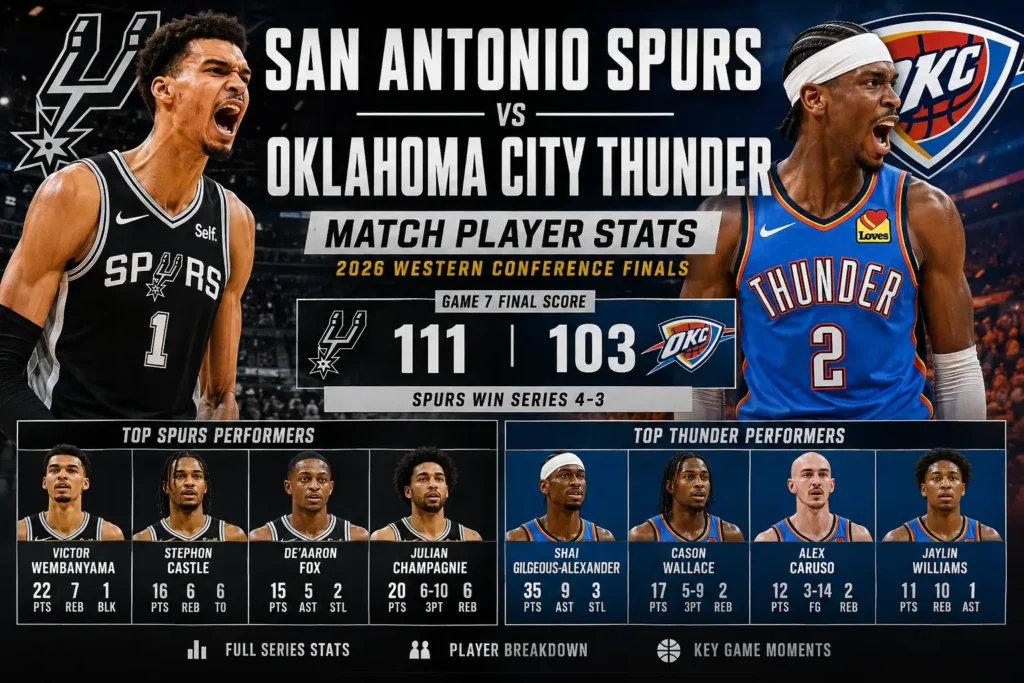
- Game 7 (Oklahoma City): Spurs 111, Thunder 103
San Antonio won the series 4-3, stealing Game 7 on the road against the top-seeded Thunder before advancing to the NBA Finals, where they eventually fell to the New York Knicks in five games.
Game 7 Box Score Breakdown
Team Totals
San Antonio shot 45.5% from the field and a scorching 42.5% from three-point range on 40 attempts, compared to Oklahoma City’s 44.6% overall shooting and 34.3% from deep. The Spurs also won the possession battle in a few key areas: 15 offensive rebounds to Oklahoma City’s 10, and a big 19-9 edge in fast-break points that reflected San Antonio’s ability to push tempo in a game that stayed close throughout.
Shai Gilgeous-Alexander’s Heroic Effort Wasn’t Enough
Shai Gilgeous-Alexander was sensational in the loss, scoring a game-high 35 points on 12-of-21 shooting, adding 9 assists, 3 steals, and a block. His 67.7% true shooting percentage reflected genuinely elite efficiency on high volume, but it came up just short against a Spurs team that got contributions from up and down its roster.
Victor Wembanyama and San Antonio’s Balanced Attack
Victor Wembanyama led San Antonio with 22 points on 46.7% shooting, including 3-of-5 from three-point range, adding 7 rebounds, 2 assists, a steal, and a block. But the real story was San Antonio’s depth: Stephon Castle added 16 points and 6 rebounds despite 6 turnovers, De’Aaron Fox chipped in 15 points and 5 assists, Dylan Harper added 12 points on efficient 5-of-8 shooting, and Julian Champagnie caught fire off the bench with 20 points on 6-of-10 shooting, including 6-of-10 from three-point range.
Oklahoma City’s Supporting Cast Struggled to Match SGA
Cason Wallace was a bright spot for the Thunder with 17 points on 6-of-10 shooting, including 5-of-9 from three, but Alex Caruso struggled badly, shooting just 3-of-14 for 12 points, and Jaylin Williams’ double-double (11 points, 10 rebounds) wasn’t enough to offset the inefficiency elsewhere on the roster. Chet Holmgren managed only 4 points on 1-of-2 shooting in a limited offensive role.
The Fourth Quarter Sealed It
San Antonio outscored Oklahoma City 31-26 in the fourth quarter of Game 7, holding on after a tight, back-and-forth first three quarters where the largest lead for either team never exceeded 14 points. That kind of closing execution, on the road, in a Game 7, against the regular season’s best record, is exactly the sort of performance that defines a series.
Series-Long Player Performance Trends
San Antonio’s Depth Was the X-Factor
Across the seven games, San Antonio consistently found different players stepping up — Champagnie’s Game 7 shooting explosion followed a series-long pattern where the Spurs’ role players complemented Wembanyama and Fox rather than disappearing in big moments, which proved to be the deciding difference against a Thunder team more heavily reliant on Gilgeous-Alexander individually.
Gilgeous-Alexander Carried an Enormous Offensive Burden
SGA’s numbers throughout the series were consistently excellent, but the burden of carrying Oklahoma City’s offense largely fell on him alone in the biggest moments, and when his teammates had off shooting nights — as several did in Game 7 — the Thunder simply didn’t have enough secondary scoring punch to compensate.
Wembanyama’s Two-Way Presence Was a Series-Long Constant
Even when his own shot wasn’t falling in a specific game, Wembanyama’s rebounding, shot-blocking, and floor-spacing as a shooting big gave San Antonio a genuine matchup advantage that Oklahoma City had to account for on both ends throughout the series.
Common Mistakes When Reading Playoff Series Stats Like This
- Judging the series purely off Gilgeous-Alexander’s individual numbers. SGA’s stat line was excellent virtually every game, which makes it tempting to assume Oklahoma City’s losses came down to him underperforming — in reality, it was almost always his supporting cast’s efficiency that decided the outcome.
- Overlooking bench scoring swings. Julian Champagnie’s 20-point Game 7 off San Antonio’s bench was a genuine series-long pattern of role players stepping up, not a one-off, and it’s exactly the kind of secondary production that decides close Game 7s.
- Ignoring turnover-heavy performances buried in a strong box score. Stephon Castle’s 16 points looked solid, but his 6 turnovers in a tightly contested Game 7 were a real factor worth weighing against the raw scoring total.
- Treating a 4-3 series as more decisive than it actually was. With four of the seven games decided by single digits or a competitive double-digit margin, this was a genuinely even series that came down to a handful of possessions across two teams’ entire season.
Best Practices for Following a Playoff Series Like This
- Check the full game-by-game results before drawing conclusions from a single box score, since conference finals series often swing multiple times before settling.
- Look at bench scoring and role-player efficiency alongside star performances, since depth frequently decides Game 7s more than any single superstar’s stat line.
- Use official sources like NBA.com or Basketball-Reference for verified box scores rather than relying on secondhand recaps.
- Pay attention to turnovers and shooting efficiency together, not just raw point totals, when evaluating how much an individual performance actually contributed to winning.
Personal Experience
I watched this series closely mostly because of the Wembanyama-versus-SGA storyline, and what struck me most by Game 7 was how little the eventual result actually hinged on either superstar underperforming. Gilgeous-Alexander was genuinely excellent in the deciding game — 35 points on efficient shooting is about as good as it gets — and Wembanyama, while solid, wasn’t necessarily the best player on the floor that night either. It was San Antonio’s depth, specifically Julian Champagnie catching fire from three off the bench, that actually tipped the scales.
That was a good reminder for how I now approach reading playoff box scores. I’d gone into Game 7 expecting the story to be written by whichever star had the better individual matchup, and instead the actual difference-maker was a role player who wasn’t necessarily the focus of any pregame breakdown. It reinforced something worth keeping in mind for any close playoff series: the star matchup gets the headlines, but the depth chart usually decides who actually wins a Game 7.
The other thing that stood out, going back through the series afterward, was how much Stephon Castle’s turnover numbers fluctuated game to game. In Game 7 specifically, his 6 turnovers against 6 assists was a genuinely mixed bag buried underneath a respectable 16-point scoring total. It’s a good example of why I’ve started checking assist-to-turnover ratios more closely rather than just scanning the points column — a player can have a “fine” scoring night on the surface while actually costing their team several extra possessions in a game decided by a margin as tight as this one was.
FAQs
1. Who won the Spurs vs Thunder 2026 Western Conference Finals? The San Antonio Spurs won the series 4-3, closing it out with a 111-103 road win in Game 7 against the top-seeded Oklahoma City Thunder.
2. Who had the best individual performance in Game 7? Shai Gilgeous-Alexander led all scorers with 35 points for Oklahoma City in the loss, while Victor Wembanyama led San Antonio with 22 points and Julian Champagnie added a crucial 20 points off the bench.
3. What decided the Spurs-Thunder series? San Antonio’s depth beyond Wembanyama and Fox, particularly bench scoring from players like Julian Champagnie, proved decisive against a Thunder team that leaned heavily on Shai Gilgeous-Alexander individually, especially once his supporting cast had inconsistent shooting nights.
4. How far did San Antonio advance after beating Oklahoma City? The Spurs advanced to the NBA Finals, where they ultimately lost to the New York Knicks in five games.
5. Where can I find the official box scores for this series? Verified box scores and game logs are available through NBA.com’s official stats section and Basketball-Reference, both of which track official league data for every playoff game.
Conclusion
The San Antonio Spurs vs Oklahoma City Thunder 2026 Western Conference Finals lived up to its billing as a genuine heavyweight matchup, going the full seven games between the conference’s top two seeds. Shai Gilgeous-Alexander’s brilliant Game 7 performance ultimately wasn’t enough to overcome San Antonio’s superior depth, with role players like Julian Champagnie stepping up alongside Victor Wembanyama and De’Aaron Fox to steal a road win in the deciding game. Beyond just who won, this series is a strong example of how secondary scoring and bench production often matter as much as star power when a series comes down to a single Game 7.
Actionable takeaways:
- Look at bench and role-player production, not just star scoring totals, when evaluating what actually decided a close playoff series.
- Check assist-to-turnover ratios alongside point totals for a fuller picture of an individual performance’s real impact.
- Track the full game-by-game series log rather than judging a series solely by its final result.
- Use verified official sources for box score data rather than relying on secondhand recaps.
For further reading on this series and the surrounding 2026 playoffs, see ESPN’s NBA playoff coverage, The Athletic’s in-depth playoff analysis, and Cleaning the Glass’s advanced NBA statistics and shot-quality breakdowns.
If you’re following sports storylines like this alongside your regular news reading, Dailynewstime is worth a look for broader daily coverage.
Disclaimer: This article is for general informational purposes only and reflects publicly available statistics from the 2026 NBA playoffs. Player stats and series results are accurate as of the time of writing — always check official sources like NBA.com for the most current data. This content is not affiliated with or endorsed by the NBA, the San Antonio Spurs, or the Oklahoma City Thunder.