
Introduction
The San Antonio Spurs vs Minnesota Timberwolves Western Conference Semifinal in the 2026 NBA playoffs was billed as a clash of styles — a young, ascending Spurs core built around Victor Wembanyama against a battle-tested Minnesota team fresh off a hard-fought first-round win over Denver. What played out was a series that stayed competitive through the middle games before San Antonio pulled away decisively, closing things out with one of the most lopsided box scores of the entire postseason.
If you’re searching for Spurs vs Timberwolves match player stats, whether for fantasy research, betting context, or just catching up on a series you missed, this breakdown covers the full results, the decisive Game 6 box score, and the individual performances that actually swung it.
The Series at a Glance
Minnesota and San Antonio traded wins through the first four games before the Spurs took control down the stretch:
- Game 1 (San Antonio): Timberwolves 104, Spurs 102
- Game 2 (San Antonio): Spurs 133, Timberwolves 95
- Game 3 (Minnesota): Spurs 115, Timberwolves 108
- Game 4 (Minnesota): Timberwolves 114, Spurs 109
- Game 5 (San Antonio): Spurs 126, Timberwolves 97
- Game 6 (Minnesota): Spurs 139, Timberwolves 109
San Antonio won the series 4-2, closing it out on the road in Minnesota with a dominant 30-point win. The Spurs went on to reach the Western Conference Finals before eventually advancing to the NBA Finals, where they fell to the New York Knicks in five games.
Game 6 Box Score Breakdown
Team Totals
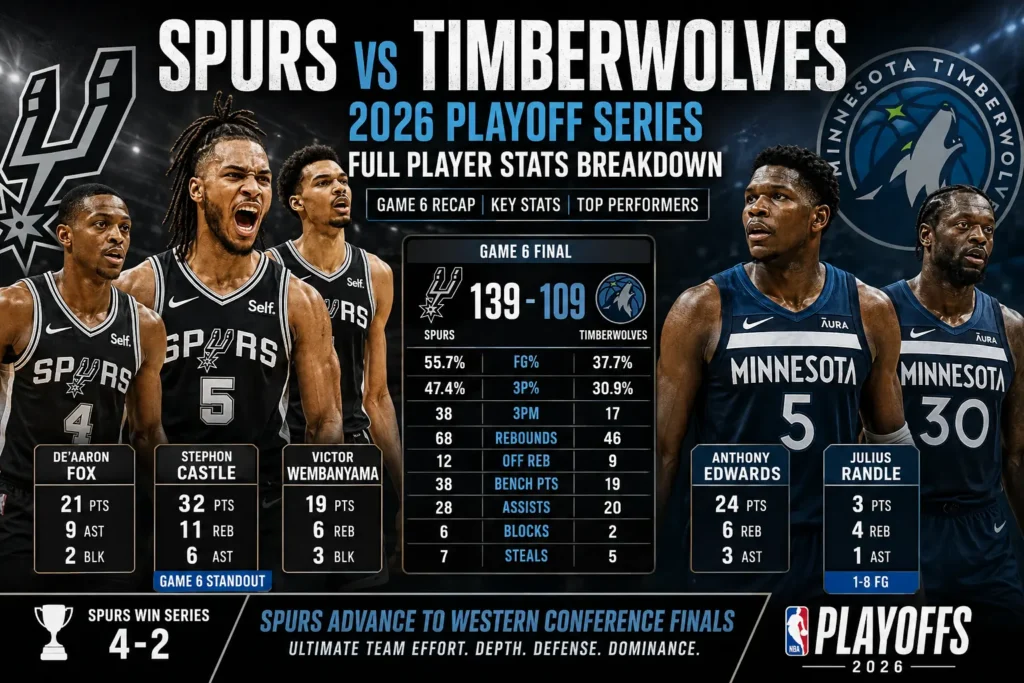
San Antonio’s closeout performance was efficient across the board: 55.7% shooting from the field compared to Minnesota’s 37.7%, and a scorching 47.4% from three-point range on 38 attempts. The Spurs also dominated the boards, out-rebounding Minnesota 68-46, including a 12-9 edge on the offensive glass, and their bench outscored Minnesota’s reserves 38-19 despite the Timberwolves actually getting 59 total bench points overall in a game where their starters struggled badly.
Stephon Castle’s Breakout Night
The standout individual performance belonged to Stephon Castle, who exploded for 32 points on a remarkably efficient 11-of-16 shooting, including 5-of-7 from three-point range, adding 11 rebounds and 6 assists for a double-double. His plus-28 rating led all Spurs players, and his 85.8% true shooting percentage on 18-plus true shooting attempts reflected just how clean his shot selection was throughout the game.
De’Aaron Fox and Victor Wembanyama Provided the Foundation
De’Aaron Fox was nearly perfect, going 8-of-10 from the field including a flawless 3-of-3 from three, finishing with 21 points, 9 assists, and 2 blocks. Victor Wembanyama added 19 points, 6 rebounds, and 3 blocks on 54.5% shooting, anchoring San Antonio defensively even in a game that didn’t require much heavy lifting once the lead ballooned.
Julian Champagnie’s Efficient Shooting Off the Bench
Julian Champagnie added 18 points on 5-of-10 shooting, including 4-of-9 from three-point range, giving San Antonio’s bench real scoring punch that compounded Minnesota’s problems as the game got out of hand.
Minnesota’s Struggles
Anthony Edwards led Minnesota in scoring with 24 points but needed 26 shot attempts to get there, shooting just 34.6% from the field. Julius Randle had a rough night, managing just 3 points on 1-of-8 shooting. Terrence Shannon Jr. was a bright spot off Minnesota’s bench with 21 points on 53.3% shooting, but it wasn’t nearly enough to offset the rest of the roster’s inefficiency against a red-hot Spurs team.
The Game Got Away Early
San Antonio built its lead systematically, outscoring Minnesota in every single quarter and reaching a 37-point advantage at its peak. A 20-point unanswered run for San Antonio during the game reflected just how thoroughly Minnesota’s defense broke down once shots started falling for the Spurs.
Series-Long Player Performance Trends
San Antonio’s Depth Was the Difference in Closeout Games
Across the series, San Antonio consistently found different players stepping up in big moments — Castle’s Game 6 explosion followed a pattern where the Spurs’ role players, not just Fox and Wembanyama, delivered when it mattered most.
Anthony Edwards Carried a Heavy Offensive Burden
Edwards was Minnesota’s clear primary scoring option throughout the series, but his shot volume and efficiency varied significantly game to game — a sign that Minnesota’s offense leaned heavily on his shot-making rather than consistent secondary scoring, which became a real liability once his efficiency dipped in the decisive game.
Wembanyama’s Two-Way Impact Was a Series-Long Constant
Even in games where his scoring wasn’t the headline, Wembanyama’s rebounding and shot-blocking presence was a steady factor across the series, giving San Antonio a defensive anchor that Minnesota struggled to consistently score around.
Common Mistakes When Reading Playoff Series Stats Like This
- Judging the whole series off one blowout game. Game 6’s 30-point margin doesn’t reflect how competitive the first four games actually were — always check the full game log before assuming a series was one-sided throughout.
- Overlooking shot volume versus efficiency. Anthony Edwards’ 24 points on 26 attempts looks productive at a glance, but the shooting percentage tells a very different story than a more efficient outing would.
- Ignoring bench production trends. Terrence Shannon Jr. and Julian Champagnie both delivered strong scoring nights off their respective benches — role player performances like these often explain the swing in a series better than star matchups alone.
- Treating rebounding gaps as a minor stat. San Antonio’s 68-46 rebounding advantage in Game 6 created extra possessions that compounded Minnesota’s shooting struggles, and that kind of possession-level gap is often a bigger story than the box score’s point totals suggest.
Best Practices for Following a Playoff Series Like This
- Check the full game-by-game results before drawing conclusions from a single lopsided game, since playoff series often stay close before one team pulls away.
- Look at shooting efficiency and shot attempts together, not point totals alone, when evaluating an individual performance.
- Use official sources like NBA.com or Basketball-Reference for verified box scores rather than relying on secondhand recaps.
- Pay attention to which role players are having standout nights, since breakout performances from non-stars often decide closeout games.
Personal Experience
I tuned into this series mostly to watch Victor Wembanyama, given how much buzz surrounded his development that season, and ended up walking away far more impressed by Stephon Castle’s Game 6 performance than anything from the Spurs’ bigger names. Watching a 32-point, 11-rebound, 6-assist night unfold from a player who wasn’t the headline act going into the series was a genuinely useful reminder that playoff closeout games often get decided by exactly this kind of breakout, not just star power.
What surprised me most, going back through the series after the fact, was how competitive the first four games actually were compared to how the series ended. I’d assumed, based on the final result, that San Antonio had simply been the better team throughout, but checking the game-by-game scores showed a genuinely back-and-forth series until Game 5, when the Spurs seemed to find another gear that Minnesota never really answered. That’s exactly the kind of thing you’d miss if you only looked at the final head-to-head record without checking individual game margins.
The other thing that stuck with me: Anthony Edwards’ stat line in Game 6 looked reasonably productive if you only glanced at the 24 points, but the 26 shot attempts and 34.6% shooting told a much less flattering story once I actually checked the efficiency numbers. It reinforced something I try to apply now whenever I’m evaluating any player’s playoff performance — always check shot attempts alongside the points total, because volume scoring on poor efficiency is a very different outcome than the same point total on a reasonable number of shots.
FAQs
1. Who won the Spurs vs Timberwolves 2026 playoff series? The San Antonio Spurs won the series 4-2, closing it out with a dominant 139-109 win in Game 6 on the road in Minnesota after the two teams traded wins through the first four games.
2. Who had the best individual performance in the deciding Game 6? Stephon Castle led all scorers with 32 points on 11-of-16 shooting, adding 11 rebounds and 6 assists for a double-double, while De’Aaron Fox and Victor Wembanyama also had strong efficient performances for San Antonio.
3. What decided the Spurs-Timberwolves series? San Antonio’s depth and efficient shooting in the closing games, combined with a significant rebounding advantage in Game 6, proved decisive after a competitive first four games that Minnesota was genuinely in contention to win.
4. How far did San Antonio advance after beating Minnesota? The Spurs went on to reach the Western Conference Finals and eventually the NBA Finals, where they lost to the New York Knicks in five games.
5. Where can I find the official box scores for this series? Verified box scores and game logs are available through NBA.com’s official stats section and Basketball-Reference, both of which track official league data for every playoff game.
Conclusion
The Spurs vs Timberwolves 2026 Western Conference Semifinal was a genuinely competitive series that ultimately turned on San Antonio’s depth and efficiency down the stretch, capped by a breakout Game 6 performance from Stephon Castle that outshined even Victor Wembanyama and De’Aaron Fox on the stat sheet. Minnesota’s reliance on Anthony Edwards’ shot-making, without enough consistent secondary scoring, became a real vulnerability once San Antonio’s role players started hitting shots at a high clip. Beyond just who won, the series is a solid reminder that a lopsided final game doesn’t necessarily reflect how close a series was for most of its run.
Actionable takeaways:
- Check the full game-by-game series log rather than judging a series solely by its most lopsided result.
- Look at shot attempts alongside point totals to separate efficient scoring from high-volume, low-efficiency performances.
- Track bench and secondary scoring performances, since breakout games from role players often decide closeout games.
- Use verified official sources for box score data rather than relying on secondhand recaps.
For further reading on this series and the surrounding 2026 playoffs, see ESPN’s NBA playoff coverage, The Athletic’s in-depth playoff analysis, and Cleaning the Glass’s advanced NBA statistics and shot-quality breakdowns.
If you’re following sports storylines like this alongside your regular news reading, Dailynewstime is worth a look for broader daily coverage.
Disclaimer: This article is for general informational purposes only and reflects publicly available statistics from the 2026 NBA playoffs. Player stats and series results are accurate as of the time of writing — always check official sources like NBA.com for the most current data. This content is not affiliated with or endorsed by the NBA, the San Antonio Spurs, or the Minnesota Timberwolves.