
Key Insights (Fast Summary)
- AI is shifting from assistants to autonomous agents that execute tasks
- Identity verification is now the biggest bottleneck in safe AI adoption
- Technologies from Pindrop and Anonybit are solving this problem in new ways
Introduction: The Real Problem Isn’t AI — It’s Identity
Everyone talks about how powerful AI has become, but very few talk about the real risk behind it.
If an AI can send money, approve access, or manage accounts…
how do you make sure it’s acting for the right person?
This is where most systems still break.
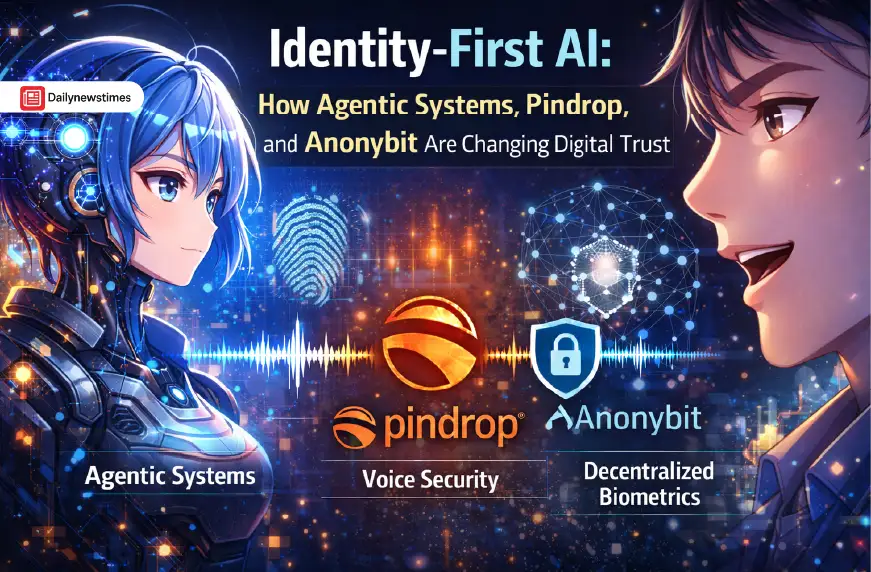
The concept of Agentic AI Pindrop Anonybit is built around fixing that exact gap. Instead of treating identity as a one-time login step, it turns identity into a continuous, intelligent verification layer—powered by voice recognition and decentralized biometrics.
And yeah, with deepfake scams getting scary realistic, this shift isn’t optional anymore.
The New Stack: AI + Voice + Decentralized Identity
Let’s look at how this ecosystem is different from older models.
1. Agentic AI: Systems That Execute, Not Just Respond
Agentic AI isn’t about chatting—it’s about doing.
These systems can:
- Complete multi-step workflows
- Make decisions based on context
- Interact with APIs and real-world systems
This is the kind of AI businesses actually want… but it comes with higher risk if identity isn’t secure.
2. Voice as a Security Layer with Pindrop
Voice is becoming one of the most reliable identity signals.
What makes Pindrop interesting is that it doesn’t just “listen”—it analyzes:
- Voiceprints (unique vocal patterns)
- Device signatures
- Call metadata and behavioral signals
So even if someone tries to fake a voice, the system can often detect inconsistencies.
3. Privacy-First Biometrics from Anonybit
Traditional biometric systems store data in one place. That’s risky.
Anonybit flips this model by:
- Splitting biometric data into fragments
- Distributing it across multiple nodes
- Reconstructing it only when needed
This means there’s no “honeypot” database for hackers to attack.
Why Businesses Are Paying Attention
Security teams and AI teams are finally starting to align.
Organizations like National Institute of Standards and Technology have long warned about weak authentication systems. Now, with AI becoming more powerful, those warnings are becoming urgent.
What’s Driving Adoption?
- Rapid growth in AI automation tools
- Increased fraud using synthetic voices
- Pressure to improve user experience (no one likes passwords anymore)
In short, companies need systems that are both secure and seamless—which is not easy to balance.
A Practical Example: What Happens Behind the Scenes
Imagine this scenario.
You contact your bank and request a fund transfer.
Here’s what happens in an Agentic AI Pindrop Anonybit setup:
- Your voice is analyzed instantly by Pindrop
- Your identity is confirmed using decentralized biometric fragments via Anonybit
- An AI agent processes your request and executes it
- The system keeps monitoring your behavior during the session
No passwords No waiting. No repeated verification steps.
It’s smooth—but more importantly, it’s secure.
Where This Model Is Making an Impact
Financial Institutions
Banks are early adopters because fraud costs are massive.
With this approach:
- Transactions happen faster
- Identity checks are stronger
- Fraud losses are reduced
Enterprise Customer Support
Call centers deal with identity verification all day.
Using voice + AI:
- Verification becomes invisible to users
- Support becomes faster
- Fraud detection improves significantly
Healthcare Systems
Patient identity errors can be critical.
Decentralized biometrics help:
- Protect sensitive records
- Reduce unauthorized access
- Maintain compliance standards
AI-Powered Digital Assistants
The next generation of assistants won’t just suggest—they’ll act.
But without secure identity, that’s risky.
This model ensures:
- Actions are authorized
- Users remain in control
- Data stays protected
Benefits That Stand Out
| Feature | Impact |
|---|---|
| Continuous Verification | Identity checked throughout interaction |
| Reduced Friction | No passwords or manual steps |
| Strong Fraud Protection | Detects deepfakes and anomalies |
| Privacy by Design | No central storage of biometrics |
| AI Enablement | Safe automation becomes possible |
Limitations (And Why They Matter)
No system is perfect, and this one has challenges too.
Technical Complexity
Integrating AI, voice tech, and decentralized identity isn’t plug-and-play.
Cost Considerations
Solutions from companies like Pindrop can be expensive for smaller teams.
User Perception
Some users still feel uneasy about biometric systems, even if they’re safer.
Evolving Regulations
Governments are still defining rules around AI and identity systems.
Old vs New: A Clear Shift
| Aspect | Older Systems | New Identity-First Model |
|---|---|---|
| Login | Passwords | Voice + biometrics |
| Security | Static | Continuous |
| AI Role | Passive | Active |
| Fraud Handling | Reactive | Preventive |
| Data Storage | Centralized | Distributed |
How to Start Moving in This Direction
If you’re planning to adopt this approach, don’t try to do everything at once.
Step 1: Strengthen Authentication
Introduce voice-based verification systems first.
Step 2: Secure Data Storage
Move away from centralized biometric databases.
Step 3: Add Controlled Automation
Start with limited AI-driven workflows before scaling.
Step 4: Follow Standards
Use frameworks from National Institute of Standards and Technology to guide implementation.
Quick Reality Check
Ask yourself:
- Are your systems still dependent on passwords?
- Can your AI safely execute actions today?
- Are you protected against synthetic identity attacks?
If not, there’s a gap—and it’s growing.
FAQs
What is the main goal of agentic AI?
To enable AI systems to independently complete tasks and workflows.
Why is voice considered secure?
Because it combines unique biological traits with behavioral patterns, making it harder to fake.
What makes decentralized biometrics safer?
There’s no single database to hack, reducing large-scale breach risks.
Is this the future of authentication?
It’s not the only path, but it’s one of the strongest emerging models in enterprise environments.
Conclusion: AI Needs Trust to Scale
AI is becoming more capable every day. But capability without trust is a risk.
The combination of agentic AI with solutions from Pindrop and Anonybit shows where things are heading—a world where identity is verified continuously, and AI can safely act on behalf of users.
Final Takeaways
- Identity is no longer a login step—it’s an ongoing process
- Secure AI requires more than just good models
- Businesses need to rethink authentication from the ground up
Because in the end, if AI is going to represent you… it needs to know you, not just assume it.
Visit: Dailynewstime