
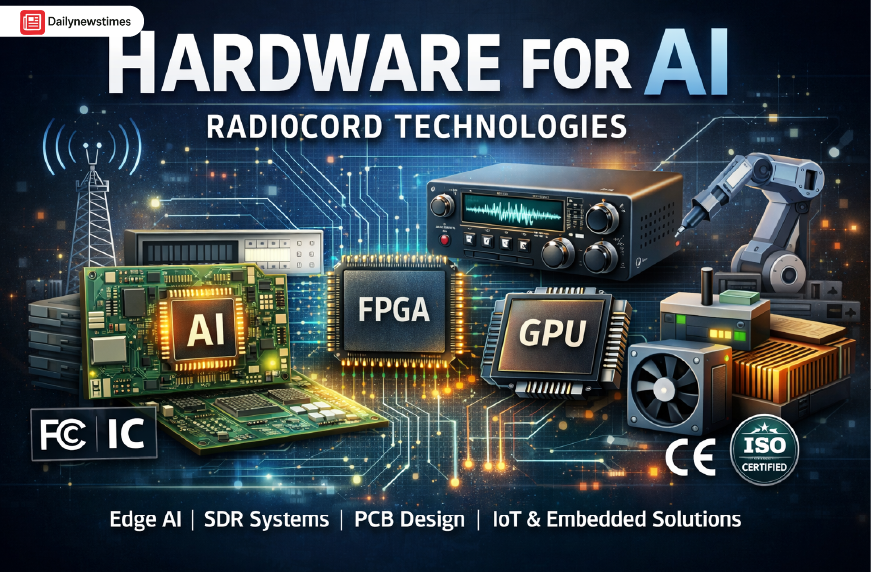
Most discussions around AI focus heavily on software, models, and cloud platforms. But in reality, none of that works without the right hardware foundation. When we talk about Hardware for AI Radiocord Technologies, we are really talking about the complete physical infrastructure required to build intelligent, connected, and real time capable systems. This includes processors, RF modules, PCB design, firmware development, and edge devices working together as one cohesive system.
Here’s the thing, building hardware for AI systems is not just about picking a powerful chip. It’s about making sure everything—from power delivery to memory bandwidth to signal integrity—works reliably in the real world. And if it doesn’t, the cost of failure can be huge, both financially and operationally. That’s why companies like Radiocord Technologies position themselves as full-stack engineering partners, covering hardware, firmware development, IoT systems, and manufacturing consultancy.
In a fast paced digital world, where devices must be smarter and more autonomous, having the right hardware is absolutely crucial. Whether you’re building an IoT device, industrial system, or AI-powered radio platform, the hardware choices you make early on will define performance, scalability, and success.
Understanding Hardware for AI Radiocord Technologies
Radiocord Technologies is recognized as a Canadian engineering design company specializing in end-to-end product development including pcb design, embedded systems, AI integrations, and IoT systems. This means the phrase Hardware for AI Radiocord Technologies should be understood as a holistic hardware stack rather than a single product.
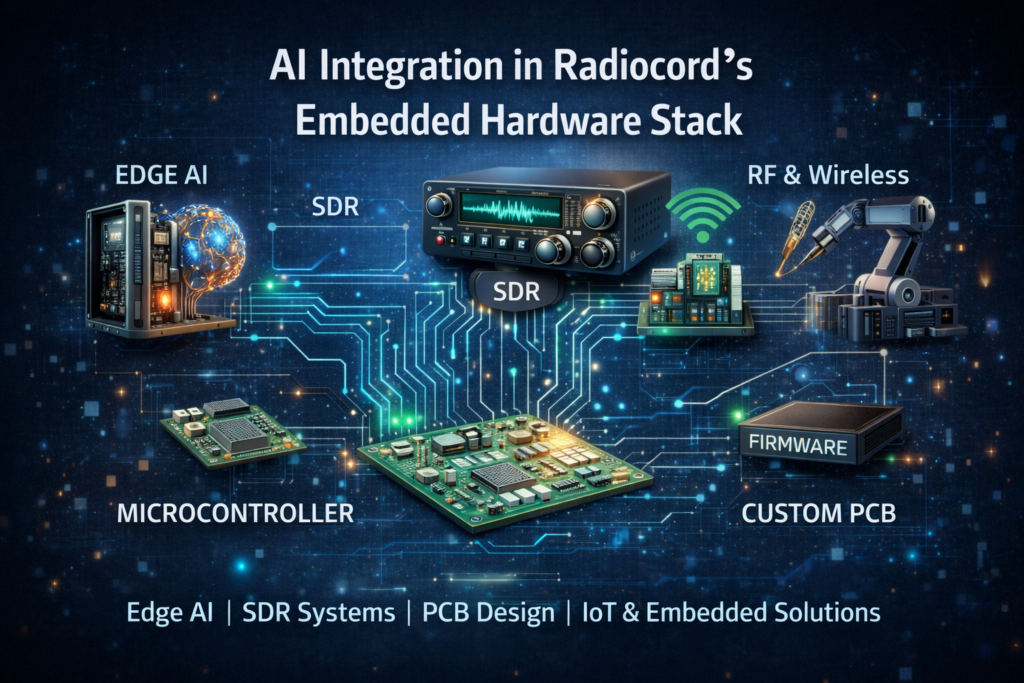
It typically includes:
- Edge computing modules for AI systems
- Microcontrollers and processors for control and logic
- Wireless and RF communication hardware
- Software-defined radio platforms
- Custom PCB design and embedded architecture
- Device firmware and system-level optimization
This layered approach ensures that machine learning models can operate efficiently on edge devices, while still maintaining connectivity and reliability across environments.
Industry Shift Toward Specialized AI Hardware
Modern AI hardware is increasingly moving toward special purpose architectures. Instead of relying on general-purpose CPUs, systems now combine CPUs, GPUs, and FPGAs to handle different workloads efficiently. This shift is supported by initiatives like DARPA’s SDR 4.0 program, which focuses on improving RF signal processing using heterogeneous hardware stacks.
Similarly, NIST highlights that future AI performance depends heavily on hardware innovation, particularly in energy efficiency and data movement. This confirms a major trend: AI systems are no longer software-first—they are hardware-defined.
Core Hardware Components for AI Radiocord Technologies
1. Edge AI Processors for Real-Time Intelligence
Edge AI processors are responsible for executing machine learning models locally. These processors enable real time decision-making without relying on cloud infrastructure. This is especially important for industrial systems, autonomous devices, and critical applications.
Examples include GPU-enabled modules, NPUs, and embedded AI accelerators. These systems are designed for high performance workloads such as image recognition, predictive analytics, and signal processing.
2. Microcontrollers for Control and Efficiency
Microcontrollers are still essential in AI-enabled systems. They manage sensors, control logic, and communication tasks. In many iot device applications, microcontrollers handle lightweight AI tasks using TinyML models.
This balance between efficiency and capability makes them ideal for low-power deployments.
3. Wireless and RF Hardware for Connectivity
Connectivity is at the core of any modern iot systems. Hardware must support communication protocols such as Wi-Fi, Bluetooth, LTE, and LoRa. For more advanced applications, RF components and antennas must be carefully designed to ensure signal stability.
In AI-driven communication systems, wireless hardware must also support adaptability, enabling smarter spectrum usage and interference handling.
4. Software-Defined Radio (SDR) Platforms
SDR platforms allow radio systems to be controlled through software rather than fixed hardware. When combined with AI, they enable intelligent signal classification and adaptive communication.
For example, Deepwave’s AIR-T platform integrates CPU, GPU, and FPGA to deliver advanced RF processing capabilities. This is a clear example of how ai integrations are transforming communication systems.
5. PCB Design and System Architecture
PCB design is one of the most critical aspects of AI hardware development. High-speed signals, RF traces, and power distribution must be carefully managed to ensure system stability.
Radiocord Technologies emphasizes PCB design as a core service, which makes sense because poor layout can completely undermine even the most powerful hardware.
6. Firmware Development and Embedded Systems
Firmware development bridges hardware and software. It ensures that hardware components communicate effectively and perform as expected.
Strong device firmware is essential for:
- Hardware initialization
- Real-time processing
- Communication protocols
- System updates and security
Without robust firmware, even the best hardware setup will fail in production.
7. Power and Thermal Management
AI hardware consumes significant power, especially during inference tasks. Proper power management and thermal design are essential for maintaining performance and reliability.
This becomes even more important when scaling to mass production, where efficiency directly impacts cost and longevity.
Comparison: MCU vs MPU vs GPU for AI Tasks
| Component | Power Consumption | Cost | Performance | Best Use Case |
|---|---|---|---|---|
| MCU | Low | Low | Basic | Simple IoT devices, TinyML |
| MPU | Medium | Medium | Moderate | Edge devices, embedded systems |
| GPU | High | High | High | Advanced AI systems, real-time analytics |
Compliance and Certification Challenges
One area often overlooked is compliance. AI-enabled RF devices must meet strict regulatory standards such as FCC (USA), IC (Canada), and CE (Europe). These certifications ensure that devices do not interfere with other systems and operate safely.
This is where engineering partners like Radiocord add significant value by guiding products through certification and validation processes.
Best Hardware Stack by Use Case
Smart IoT Devices
Use microcontrollers, wireless modules, and lightweight AI models. Focus on efficiency and cost.
Industrial AI Systems
Use edge processors, robust PCBs, and reliable firmware. Prioritize durability and performance.
AI + RF Systems
Use SDR platforms, FPGA-based architectures, and advanced RF design. Focus on adaptability and precision.
Pros and Cons
Pros
- Real-time decision making
- Reduced cloud dependency
- Enhanced system intelligence
- Better performance in remote environments
Cons
- Higher development cost
- Complex integration
- Thermal and power challenges
- Longer development cycles
Hardware Selection Checklist
Before finalizing your hardware, ask yourself:
- What level of AI processing is required?
- Will the system operate in real time?
- What are the power and thermal limits?
- Does the design support scalability and mass production?
- Are compliance requirements clearly understood?
FAQs
It refers to the complete hardware ecosystem used to build AI-enabled embedded and connected systems, including processors, RF modules, PCB design, and firmware.
Because high-speed signals and power requirements demand precise layout and thermal management.
No, many applications can run efficiently on microcontrollers or edge processors depending on complexity.
Conclusion
The future of AI is not just in software—it is in hardware. Hardware for AI Radiocord Technologies represents a complete engineering approach that combines ai systems, embedded design, firmware development, and connectivity into a single scalable solution.
As industries move toward smarter and more autonomous systems, the demand for building hardware that supports real time intelligence will continue to grow. The key is to stay practical: choose hardware based on real needs, design for scalability, and never underestimate the importance of system-level integration.
And honestly, the teams that get this balance right—between performance, cost, and reliability—are the ones that win in the long run.
Visit : Dailynewstime